Choose Your Language

Thursday, 16 September 2010

The Definitive Crafting System

This week, I decided to try to finish the tome Crafting With The Greater Essences that helps to describe crafting methods when using the Greater Essences. Like its predecessor, Crafting Recipes From The Past, it is a fully comprehensive guide on many recipes available in the game, all compiled into one easy reference tome. Both of these tomes use my Readable Book format with a dedicated contents guide and are designed to make crafting much simpler! As I started to work on the tome, however, I decided I needed to update the crafting system one more time, to make it much more streamlined than I had currently made it and even more user-friendly. I did this, because I believe that most of the problems and dislike from people when using a crafting system is because of the many differences and complications normally entailed. Here are the opening pages of the two tomes in question:


Cost 5gp and obtained (when available) from any good alchemist.


Cost 5gp and obtained (when available) from any good alchemist.

All Recipes Rolled Into One

The first tome, entitled Crafting Recipes From The Past, covers every crafting recipe that came with the first official campaign, with many recipes covering the lesser essences and gems. Not every recipe included in this tome requires such, but if it was a recipe that was detailed in a book from the first official campaign, then this tome has it covered. The second tome, entitled Crafting With The Greater Essences, does the same thing of amalgamating all the recipes into one book, but for those recipes that were found in the second official campaign, Mask of the Betrayer.

The beauty of this, is that the player no longer has to hunt around trying to locate the recipe they need among the many books, or struggle to recall what it is they need to have to qualify, as all the details have been carefully laid out in such a way to make finding a valid and useful recipe reasonably quickly. It is even possible to easily consider a plan of enhancement or creation ahead of time because the crafter has all the relevant details to hand.

Finally, with the introduction of Storms of Zehir, the player was introduced to a third recipe system. Thankfully, this system introduced recipe books straight away, and so the newer recipe system complements the two described here well. However, I have made one distinction of the newer recipes, and that is they act more like magikal pages that are used up when they are used to help enhance or create an item. Therefore, the modern recipe books can hold more than one copy of the same recipe, simply because you need a separate copy of the recipe for each time you wish to carry out its formula.

Crafting In Practice

The entire crafting scripts have undergone comprehensive changes to help iron out many of the differences and inconsistencies between them, which I will mention in a minute. I have also edited many cost related 2da files to ensure crafted items do not upset the economy of the world and reflect sensible values between ingredients used and final product. I have even fixed one or two broken recipes along the way.

First off, I would like to show some screenshots of some of the items, tools and recipes involved in crafting, to help demonstrate how much easier working with crafting will be in Better The Demon. The first collection of tools for the crafter involve bags, the primary one being the Crafting Satchel (cost 2gp and readily available from any good alchemist):


This bag is invaluable for anybody who wants to keep their crafting items in order. Any crafting items found are automatically moved into this bag if carried, making searching for specific crafting items much easier when required. (See description.) The next screenshot shows us examining a couple of the items inside the Crafting Satchel:

Notice creature items that can be distilled into essences say as much in their description and even tell you what skill rank is required to recover the essence from the creature part. Notice also, how the mold name makes it clear what minimum Craft Weapon skill is required to work with it. The next screenshot shows a closer examination of the essences within the bag:

Notice how the essence description is not the source of the information for what it can do. To find this information, you simply look up the recipe you wish to follow within the Crafting With The Greater Essences tome. The logic is you look for and plan what you want to create from reading the tome (or any tome) and then look out for the ingredients required. You decide what to make rather than see what can be made from the essence. As an important aside, you must carry a copy of these tomes to be able to use any of the recipes within them. In other words, you cannot meta-game the recipes by referring to them outside of the game and then playing them out in the game.

As well as the Crafter's Satchel, there are a couple more satchels that a crafter may find useful to have in their inventory. That is the Alchemist's Satchel and the Enchanter's Satchel. Take a look at their descriptions in the images below:

The Alchemists' Satchel (cost 2gp and readily available from any good alchemist) is more useful to PC's who have the skill to determine creature parts that can be used in modern recipes (as opposed to creature distillable parts used to create the lesser essences). If the PC has taken the time to increase their alchemy skill, then any creature parts they find that can be used in modern recipes will be instantly recognised and placed into this satchel if carried. These parts are automatically used if and when a PC uses a modern style recipe.

The second bag is the more expensive Enchanter's Satchel, costing 100 gp and obtained (when available) from any good Alchemist. Once the crafter has established themselves and gold becomes less of an issue, then purchasing an Enchanter's Satchel is the way to go to avoid having to go back to a known bench location whenever they need to do some crafting involving a magician's workbench. It does require the power of Life Essences though to help enable its magik in the field.

Next up are the Mortar & Pestle and the Smith's Hammer: two very useful tools of the trade for any would be crafters. If alchemy is more your craft, then the mortar & pestle will be your first tool of the trade, costing around 4 gp and obtained from any good alchemist or local sundry store. On the other hand, if working with molds to create your own armour and weapons is more your thing, the you will need to pick up a smith hammer, also costing around 4 gp from a smith or local sundry store.

The most expensive tool a crafter is likely to purchase is a Shaper's Alembic; a tool designed to convert, combine or divide essences, costing around 320 gp and normally only one or two available at a time from an alchemist due to their expense. They become a much more viable tool at higher levels and when the crafter really needs to work with essences more effectively.

Note from the description, however, that all the information about skill ranks is known ahead of time and that the tool handles all essences that can be found at much lower levels than any previous campaign has allowed, making the whole system easier to get into.

Finally, take a look at some of the modern recipes available in the screenshots below. Notice (like the molds name) that these recipes include a number in their name title if the PC needs to meet a minimum caster level (for enchanting) or rank in a skill (for creating). This makes it it as easy as a glance to quickly look at the recipe name and determine if you are of high enough ability to even be able to attempt the crafting without having to look at the further details. Scrolling through the recipes available in a book will be all it takes to quickly work out if you have anything within your capabilities. You can even see from the names in these examples, that the Amulet of Health (+2) does not have a minimum figure, which means only the feat is required.


(TYPO: Longbow recipe should say Blacksmith Bench required.)

Among many of the objects you may find along the way to help with creating other items are things like ingots. Once again, any item like this that you find in the game will be clearly marked as to what type of item it might be used for. This helps remove the nagging questions or doubts about what items you need for the type of crafting you may be following:

Item Properties

One of the major problems with the different crafting systems was that they all had their own idiosyncrasies about how to add properties and what would or would not count as a property already. For example, in some systems adamantine weapons counted as having enhancements already, whereas in another, they did not count. In Better The Demon, all this has been ironed out and it a very simple case now of all weapons and armour can have a maximum of 4 magikal properties - excluding any material benefits! (*) Therefore, whether a weapon is made from adamantine or iron, both weapons can have four more properties added. The added benefits of an adamantine item are just that - additional benefits! Therefore, the system does not penalise for characters improving items created from the more exotic materials, but even enhances them further! This maximum is across the board for items, be they weapons or armour, etc. The only exception to this maximum is if the weapon is of poorer quality (a new gaming system in Better The Demon), in which case, a weapon may only hold one or two properties, or the poorest quality weapons none at all! Furthermore, it is possible for weapons to degrade if not cared for, and if they drop a level in quality, they could potentially lose a magikal property as well. Note, however, weapons cannot lose their material properties, which adds value to weapons made from exotic materials, as even the poorest quality weapons of such materials can offer benefits.


(*) Items other than weapons and armour are also set to four, but are subject to any restrictions they may have in the official rules.

Furthermore, all items can have a property upgraded even if all four property slots have been filled! In previous systems, property slots had to be "left open" to allow a property to potentially be upgraded if a higher value magikal property recipe was found. Now, for example, if you have an item with all four slots filled and you find a recipe that can improve a weapon's AC protection from +1 to +2, you can replace the old property without any problem.

This maximum number of properties and ability to upgrade an existing property is valid across any and all systems of crafting. Therefore, irrespective of which crafting system you may have adopted and used in the past, you should find it very easy to fit within the new single amalgamated system, using whichever recipe formula you have available to you at the time: be it acquiring and working with the lesser essences and gems, or obtaining the greater essences or even finding modern recipes - all of them work together to either improve existing items or allow you to create better ones. To keep track of the number of slots available, the information is given to the player as a message each time they acquire, equip or unequip the item.

Brewing Potions, Scribing Scrolls & Crafting Wands

Finally, I would like to just mention (as a side topic to crafting) that these three creation feats have taken on greater strength and ease of use in Better The Demon as well. The PC now has much more control over the power of such a creation, being given the option to upgrade the power of the item at time of creation. Scrolls, in particular, have the added benefit of automatically increasing in power along with the strength of the user. e.g. If a PC found a Magic Missile scroll at 1st level and cast it, it would release a level 1 missile. If, however, the PC did not use the scroll until they had reached 5th level, then the same scroll would cast as a 5th level Magic Missile. The idea of all these additions to the existing systems is to a) Make it easier for the player to use the system and b) Make the feats worth learning and using. As an addition, it is cheaper for a PC to create their own potions using the Brew Potion feat (or scroll or wand using the appropriate feat) than purchasing one. Therefore, they are immediately rewarded for their new found feats and could, potentially, even earn a few gold creating and selling these items along the way.


Blank scrolls cost 1 gp, potion bottles cost 3 gp and bone wands cost 10 gp where stock is available.

By the way, I never got around to finishing the tome. ;)

Saturday, 11 September 2010

Creating A Party (POLL: Your Ideal Party Size)

I have been making slow but gradual progress over the last week or so, mostly to do with the main quest. This includes trying to design an interior area as well as do a little scripting to help generate specific random items in particular circumstances based upon PCs statistics and attributes. The results are exciting to see and I look forward to hearing how players get on with this aspect of the module.

On a more unsettling note, I appear to have lost contact with Hosa, who was going to be designing some exterior areas for me. The last email I had from him was over a month ago now, and even though he seemed quite positive at the time, I have heard nothing from him at all from all my last emails trying to contact him. I have not given up hope totally, but the lack of response is disheartening.

I also had the opportunity to play a little of Wyrin's White Plume Mountain with a friend of mine. We don't play for long, but in the little time we did play, we managed to get our party together and equip ourselves. We did discover an error in the scripts that prevented players (apart from the main PC) and companions from acquiring the required XP and gold on start up, but it was easy enough to fix and I sent Wyrin an update to help him fix it. The error would not have affected anybody playing a SP game, but only those playing a MP game. If we discover any more MP bugs, I will be letting Wyrin know.

Party Creation

It was after playing Wyrin's module that I thought I would explain how my own module, Better The Demon will work with respect to party creation; especially as my module is geared towards MP play as much as SP. So, without further preamble, here is how it will work:


As soon as the host player (SP or MP game) has finished reading the introduction to the module and established the background for the party, they will be introduced to the Party Creation Rules for the campaign. This information GUI basically explains which classes are not supported in the World of Althéa and therefore not permitted to join. If a PC is imported or created with any of these anachronistic classes in it, then they will be prevented from entering the world.

The same GUI also explains that party creation is not a requirement, but merely an option. To begin with, if the player decides to take up the opportunity of rolling a party at the start of the game, then they are restricted to 3 additional PCs (to a maximum of 4) at this stage. This figure is reduced by one for each subsequent player that enters the world in a MP game.


The screenshot above shows the current party at the start of the game with the main PC already within the party (Adarkin Bundais) in a SP game. The player now has the opportunity to add 3 more PCs now, or wait to see if they find and recruit companions from the world instead. Subject to whatever the player decides to do, they will begin the game either as a single PC or a party of 4, or somewhere in between. Later on in the game, the player will be given the opportunity to increase the party again. (See next.)


Whatever the player decided to do at the start of the game, later on in the game they have the opportunity to extend their party further. This can be done by going to the local tavern and climbing the soap box stage to rally some troops, which basically brings up the Party Editor GUI again. Depending upon how the player responds to the options and whether the game is a SP or a MP game determines what happens next. In most circumstances, the current party members will be automatically temporarily dismissed (allowed to wonder the tavern) while the leader of the party "gives the speech". Basically, the player is able to create more PCs for every blank slot remaining. In a SP game, this will be another 3 PCs. In a MP game, it will be 4 minus the number of players. In other words, if there are four players joined at this stage (the maximum number of players supported), then no more PCs will be able to be created this way and only companions can be added.

The bottom line is, the party size can grow to a maximum of 6 PCs. This can comprise of any of the created PCs the lead player cares to spend time creating each time they use the soap box to rally troops. In other words, if they believe a previous created PC in not good enough for the job, then they can choose to create another one to take its place. Of course, the player does not have to use created PCs at all, but can use a complement of any companions they may find along the way to bring the party size to 6 as well. The best combination would probably be a combination of created PCs and companions. (Henchmen can be added over and above the maximum of 6 in the party. The 6 maximum is for created PCs and companions only.)

POLL: Maximum Party Size

This topic brought me to a poll I have been wanting to run for some time: What is the optimum party size in your opinion? Please cast your vote on the poll and then tell me in a comment your personal class combination in the following two circumstances:

a) What classes would you play if the party size was a maximum of 6 PCs?
b) What classes would you play if you could play any party size (if not 6)?

And tell me anything else about your party that would be interesting to know!

Wednesday, 1 September 2010

Death & Recovery

Sorry about the lack of a post last week, but personal situations prevented me having the time. (No deaths, thankfully.) This post is still a couple of days later than I hoped to have it done by, but as I was testing the code I was going to blog about, I realised I was not content with the way it was written and so spent a little time rewriting it so that it worked more efficiently. That is now done and I am much happier with the way it works. So, without further ado, I now present to you the Death System and explain how it will work in Better The Demon.


Dying Is A Drag

For players who invest time and energy into building a PC, the worst thing that can happen to them is to see their PC suddenly come to an untimely death. Whether it comes during battle, from a trap, or simply attrition, there is always that sinking feeling when you see your PC's HPs plummet to zero and they keel over dead. In NWN2, a system was introduced that meant a PC was not actually dead if someone in the party survived a battle. At the end of the battle, if there was a survivor in the party, all the PCs who had "fallen" would get back up as if they had only been knocked unconscious. While I have a degree of respect for this system, I do feel it robs the game of the impact of death, which became a lot harder to meet. For Better The Demon, I wanted to introduce an idea I had in mind since my early pen and paper days that helped in this sort of situation. This idea, however, could not be introduced until after the heroes had finished the Soul Shaker module, which is where this module begins.

Multiple Situations

Part of the complexity with the Death System for my campaign is that I have introduced a couple of gaming elements that replace the standard system. The first and most complex element I have added is something I call the Life Essence. The second element is because, unlike SoZ, when a PC dies in my campaign they remain dead! Add to this that it also has to cope with a MP game (and overland maps) and the system becomes quite involved.


The Life Essence (Soul Protection)

I have written about this item even before this blog began, and have continued to write about it on and off over the course of this blog. (I first mentioned it three years ago in an old forum post on 30th August 2007, which I reposted in this blog here.) It is probably one of the most distinguishing elements introduced in the campaign that helps mark the new era. To begin with, the PCs will not know what this item is, but not too long after they begin their adventure, they will be introduced to an "understanding of life" and the Life Essence. I won't go into any more details about this in particular (I don't want to spoil the story), but will, instead, explain a little more how this new element helps alter the way the game plays. If, however, you would like to read a little more about the Life Essence, then also read this blog.

The bottom line is that one use of the Life Essence is that it can be used to help protect a PC from untimely death, by offering Soul Protection. It also has some other very useful applications and so a player must decide on how they want to use this item in the game. As they collect more of the Life Essence, so they may be more flexible with its use, but there is always a balance to keep. By default, Soul Protection is activated from the moment the PC understands its concept. From that moment on, when a PC dies, if they have enough Life Essence on them, they will immediately be reborn with full hit points and without any ailments. In combat, a PC will not even fall to the floor as the Life Essence sustains their life and keeps them from death. In game terms, one Life Essence is required for each level the PC has acquired. E.g. A first level fighter who dies carrying three Life Essences, will have one of them used up to enable rebirth, leaving them with two. Once the PC has run out of Life Essence, they will die in the normal way. NB: The term "rebirth" is used when a PC is respawned using Life Essences, as opposed to being "respawned" using the Main Death GUI.

Resisting The Rebirth

Because the Life Essence is valuable in other ways, the player has the option to determine if their PC resists the power of the Life Essence to have them be reborn or not. Resisting is more likely to be the case if somebody in the party has the ability to raise the PC from the dead in other ways, or can pay somebody else to do it. As the PC increases in level, the Life Essence may be better saved for uses other than Soul Protection.

A Party In Action

Here is an example of how a combat might unfurl in a single player game with a party of three PCs. Hopefully, it helps to explain how the system works. A MP game plays the same way as described for the SP game except when a player's Main PC dies (and who carries insufficient Life Essences for a rebirth) then they may only continue to control another companion (not possessed by any other player) or wait until a fellow party player comes along and revives them. If all the players eventually die through lack of Life Essences, then the assigned leader for the group of players will be offered the chance to reload only. There is no respawn option available in a MP game. (UPDATE: There are some circumstances where a respawn option will be given in a MP game, such as when changing modules, or when leaving an encounter area.)

Some of the following pictures have been edited for ease of demonstration.

Brent dies without carrying any Life Essences. (A tombstone is created alongside him.) Notice Brent is no longer in the party member bar on the right hand side.


Clicking on the tombstone reveals Brent's body (that can be carried) and any items he was carrying(none in this example). It would not show "plot items" he carried, as these would have automatically have been transferred to the Main PC upon his death (in case the player had chosen to abandon the companion).


When Adaur dies carrying Life Essence, there is no tombstone - and because the player chose to have auto-rebirth turned off for this PC, the player must now stand next to the corpse to be offered a choice of Life Essence rebirth or to leave him for the time being. Notice, Adaur is also removed from the party member side bar when not using auto-rebirth. He will also have had any "plot items" he carried moved to the player's Main PC upon his death.


When the Main PC dies (Adarkin in this case), he will automatically be offered to be reborn if he carried sufficient Life Essences. The player can choose to either rebirth using some of the Life Essences Adarkin carries or reload a game. If the player had had auto-rebirth enabled for Adarkin, then the PC would have kept automatically respawning until he had run out of Life Essences.


If the Main PC had died without any remaining companions to take control of or Life Essences to be reborn with, then the player is offered the Main Game Death menu and have the option to Respawn the Main PC, but with an XP penalty.


Above are some examples of the feedback during combat, including the turn counter. In the first window, it shows the combat being initiated (the establishing round, which may not be a complete round of actions), followed shortly after by Brent dying. (He had no Life Essences on him at all and so just died leaving a tombstone.) The second window shows a combat where Adaur did have auto-rebirth enabled and lost a Life Essence on a rebirth situation. The last window shows Adarkin "apologising" to stop all further combat that had been initiated. The "Sorry" option can only be used with "good" aligned NPCs who have been attacked "by mistake". The facility can only be used after a 30 second cool down period and there are also consequences for killing innocents "by mistake" or otherwise.


Overland Travel (Death By Attrition)

In Better The Demon, an unprepared party can also die through attrition, especially in the early days when they do not have spells to support them. Even then, death by attrition is most likely to occur when the player decides to take his party on a long distance journey. There are circumstances when a party member will refuse to travel in the first place (when there is no means to supply food/water for the journey), but if travel is started, then the leader of the party (or the chosen leader for a group of players in a MP game) has the sole responsibility for all the PCs in the party.


When a party enters overland travel, it is the leader who controls where the party travel, and it is only the leader of the party that the player directly controls. (In a MP game, only the lead player controls the direction of travel for all the players, just like SoZ.) It is possible for companions to die along the way through lack of food/water, and in such circumstances if they do not have Life Essence to revive them for a short while longer (and before they die again from lack of food and water), then they will die just as if they had in battle and leave a tombstone on the map that contains their body and items. The leader must then decide for the group if they intend to take the fallen companion with them or not.


If the leader themselves dies, and they carry Life Essence, they will be revived automatically if set to do so or given the option to be reborn using Life Essences or reload a game. If they do not carry Life Essences, then they will only be given the option to reload a game at the official Death GUI. Basically, on an overland map, if the leader dies and does not have sufficient Life Essences to be reborn, then the party is considered "lost" and if there are any surviving companions at the time, then they are also considered dead. On an overland map, it makes sense to ensure the leader stays alive the longest for the sake of the party!

Monday, 16 August 2010

Time ...

I thought I would talk about the topic of "Time" this week. It is an especially difficult topic with respect to D&D (or any CRPG that involves time for that matter) simply because in almost every gaming situation the process of passing time varies from one action to another: From combat rounds to spell durations and even to timed events over days, weeks or even months. In D&D, the passing of time is handled by the DM who determines how much time passes in the world after each player action. In a CRPG like NWN, however, managing such events (in modules that do not have a DM at the helm) are not so straight forward without a robust time system being in place that can cater for the various player actions. As an aside, I found it interesting to read how the D&D rules regarding time have changed over the years: In the 1E rules, time was considered "of the utmost importance"; in the 2E rules, the importance of time became "decided almost entirely by the DM", and by the 3E rules, there is no index reference to it at all. In fact, the 1E DM's Guide even stresses in capitalised letters that, "YOU CANNOT HAVE A MEANINGFUL CAMPAIGN IF STRICT TIME RECORDS ARE NOT KEPT." So, one question is, just how important is time and its keeping?

Party Time Keeping First of all, however, I want to ask the question just how do our party of intrepid adventurers keep track of time for themselves? The passing of a day is fairly obvious, and so tracking periods of time in days, weeks and months should be considered straight forward enough, but what about more intricate time tracking? Our guide for this comes in the form of equipment that the PC can purchase from a merchant according to the D&D Player's Guide. In the 3E rules, a PC can purchase an Hourglass (25gps) and a Water Clock (1000gps); the latter not being portable. There is also the possibility to refer to a sundial on a sunny day. However, I think it may also be assumed that some ingenious gnomes will have produced a better time piece at some point in time (if you pardon the pun), but, like the Water Clock, this would be well beyond the basic adventurers need considering its cost. The bottom line is, in general, the adventurer does not need to keep track of time to the minute. For the adventurer, the most critical time they will most likely need to observe is when a ritual might be planned to take place, like the midnight hour on the first day of the year. In such circumstances, the adventurers would normally lie in wait at the site until the event occurred, thereby avoiding the need to be too specific. In my own module, Better The Demon, the recognition of a new hour is also handled by magik(*): Towers with enchantments placed upon them will chime at a new hour without the need for interaction. (*) Magik with a "k" refers to objects containing magic, rather than magic with a "c", meaning from a creature.

Game Time Keeping Most CRPGs will not track time from minute to minute, and even if they did, they would normally have a means of fast-forwarding time when required. In most NWN modules (my own included), time is scaled in such a way to allow it to pass quicker than in real life. For example, in Better The Demon, 15 minutes real time equates to 1 hour game time. However, this is not the case where combat or certain spells are involved, which can be confusing if not recognised. For example, a spell that lasts 1 minute per level will last for 15 minutes for a 15th level wizard. This spell would actually last 15 minutes real time, which equates to 1 hour game time. How one interprets this time difference is a matter of perspective during play. (See Amorphous Time below.) Furthermore, when a PC rests, time can be moved forward or not, according to both where they rest and how they rest. For example, in Better The Demon, resting at an inn will always assume 8 hours game time moves forward (regardless of when resting was started), whereas if the party chose to rest (to pass time by waiting until dawn or sunset), then only the number of hours to the specific time will pass. If there is only one hour to dawn, then only one hour will pass when rested. Better The Demon also introduces the concept of Personal Time, which I will discuss next and answers the question of how they rest.

Amorphous Time & Personal Time I have mentioned this before, but will mention it again as it is an important feature to grasp with respect to the passing of time in Better The Demon. To keep the game running smoothly and to prevent a "resting every few minutes to regain spells", resting to regain spells works around a Personal Time frame. Basically, the assumption is made that a PC can rest to regain spells once every 8 hours, and as long as they do not regain them more frequently than this, then they can rest at any time without moving time forward for the rest of the group. I call this Amorphous Time, because time effectively shifts according to the individual player's perspective. I go into an example of how it works in this post: Resting & The Passage of Time. You can also read how time affects party attrition in this post: Hunger & Vigour System.


Is Time Important? I suppose the answer to this question depends upon your own gaming background and just how much of a stickler you are when it comes to such things as resting, spell recovery, timed events and its effect with respect to travel. For me, all this is important, and so I like to make sure time is well catered for. This is why in Better The Demon any form of overland travel will be counted; all resting will be monitored and spell learning periods will be adhered to. (Time for item creation, however, will be instantaneous in Better The Demon compared to time taken in D&D.) Some may argue that adhering to these time elements is superfluous to the story and that time can be moved forward according to the stage the player is at. However, I have always seen D&D as a "free environment" in which the player can immerse themselves and follow events as they see fit. They may wander into new events and quests that demand their time, which in turn may apply time constraints when trying to complete other events. The point being, using time in this way adds a dimension of urgency to the game and causes the player to consider their actions more carefully. For example, if a cure for a poison is not found for the princess by midnight, then she dies. In this case, any form of travelling would quickly add time and so it forces the player to work within the limits that the remaining time offers them. Basically, using time in this way helps remind the player of their own limits, even when they are playing the hero.

Date System Every campaign world with a decent background and ecology usually has its own date system based upon its own historical world events. Toril (of Faerun fame) has its own unique date system and Better The Demon also has one. The problem with a world having its own calendar with different days and weeks has, thankfully, been solved by a great piece of custom work by Edward Beck's (aka 0100010) and his Custom Calendar GUI. Depending upon just how involved you want your calendar system to be, this custom content may require more coding. The personal touch it adds to the campaign, however, is well worth the effort and is very rewarding. You can see a screenshot and more info about the date system in this post: Keeping A Date.

Time To Conclude It's obvious that not every module needs a solid time system in place to allow a fun time. However, if a builder intends to present their work as a campaign (with events occurring over time throughout the world), then I do think there is a strong argument for the case of having an established time system in place. It also depends on your approach to the game and whether you prefer what is now referred to as "hard core rules" that include items and conditions that are affected by time like some of those I mentioned earlier. Yes, it involves more effort to make work, but I believe if done correctly, it can add a great deal of depth to a module transforming it from a good module into a classic module. It's true that playing with the added element of time is more difficult, but I believe the rewards for succeeding with it included are also that much more satisfying.

Time For You That's my take anyway, but what about you? Builders: How do you handle time? Do you stick with the default system or have you altered it in any way? Builders/Players: Does being allowed to rest, heal and relearn spells at any time appeal to your style of play, or do you prefer a stricter setting and background to play? Players: Do you keep track of the date at all? Do you believe timed events are important or not? Basically, tell me what you think about time in the modules you build or play!

IMPORTANT INFO: Any time constraints I use will NEVER stop the player from finishing the game. They are not to be included to frustrate the player, but to add a different slant to the game. Time constraints will have a biggest impact on when a player can rest and recover HPs and spells. Otherwise, time constraints that cannot be circumvented in any way will only appear in side quests. This gives the player a reason to choose a different path to play on a potential replay.

Saturday, 7 August 2010

The Party

"Dungeons and Dragons" (D&D) has always been about taking a party of adventurers into unknown lands and dangerous dungeons in the search of adventure, gold and fame. Yet just how big can the party be and who exactly makes up the party? What is the difference between a PC, cohorts, companions and henchmen? Many of you may already have your own ideas about this, but I hope to set out what I believe are the differences between them and how they will play in Better The Demon. To help illustrate this, I will refer to the great Lord of the Rings film, using Frodo as the main character.

Party Size: To begin with, there is nothing to stop a player from playing a party of only one character in size: their avatar and nobody else. Also, in a multi-player game, each player can play just their single PC and nobody else, but when they join together then the party size will be as big as the number of players in the session. Yet in both the single-player and multi-player game, players often like to either play more than one character determined at the "party creation" screen or find other characters that will join their company along the adventure. Determining how the players(s) take new members into the party will determine just how faithful those characters will be.

The Player Character (PC): There can only ever be one main PC for each player. This is also referred to as the player avatar: the character that represents the player within the fantasy environment. This character will always behave as the player controls them (unless dominated in some way) and will stay with the player throughout the adventure. They would represent the leader of the group of PCs that the player is playing. (In a multi-player game, an overall party leader is chosen from all the PCs that represent the different players.) In my example, I see Frodo as the character that would represent the main PC within Lord of the Rings.


Cohorts: Sometimes, however, a player likes to make their party larger than a one-man band and looks for fellow adventurers to accompany them along the way. Since the release of Storm of Zehir (SoZ), a gap has been filled in the NWN system to come closer to the D&D environment. That is, a party creation system has been introduced that allows players to create their own party with more than one character from the start of the game. In D&D, a player was always allowed to play more than one character in this way if they wanted to, and was actively encouraged to do so if there were not enough players to create a reasonable size party full of PCs. These additional characters, known as cohorts, were seen as devout followers of and always dedicated to the leader PC. As such, their statistical make-up was at the control of the player and they behaved very much like a PC as far as control was concerned: a player could always rely on knowing they were on their side. Continuing my example, Sam, Merry and Pippin would be cohorts to Frodo.


Companions: Before the introduction of cohorts (via SoZ), the closest a PC could come to finding allies for the adventure ahead came in the form of companions (unless playing with other PCs in a multi-player game of course). A companion is often (but not always) represented by an NPC ally, who is ready to help with the party cause or simply tag along for the company. As such, their motive is not always clear and they are often only to be trusted all the while they remain in service with the party. A difference of opinion or a change of influence can often end the relationship quicker than it started, and this could be catastrophic if it happened at a bad time like in the middle of negotiating terms with an enemy. As such, a companion's statistical make-up is not usually at the hand of the player. The initial build certainly isn't, with any further build being determined by the module creator at build time. Although, companions are similar to cohorts in that the player can normally control them in every other respect while they remain in the party, by having full access to their character sheets and inventory. In my example, Gandalf, Strider and Boromir would all classify as companions. In this case, Gandalf and Strider remain faithful to the main PC, Frodo, whereas Boromir does not.

Henchmen: At the bottom of the barrel and very much of the "cannon fodder" level come henchmen. Now this is not always the case and there are some very close relationships with some henchmen that may come close to companionship, but as far as gaming characters go, then, unfortunately, henchmen are the Star Trek red-shirts of the D&D world. Players have next to no control over henchmen except that the henchmen will generally support the main PC in a battle, but not even this is assured. They will often only accompany a party if they are paid in gold coins (in advance), and only then all the while the PC acts in a way they agree with. Henchmen will usually be the first to die in a party, the first to run away or leave and the last person you should trust. There are, of course, exceptions to this, but as a general rule, players have the least control over henchmen and are only able to issue basic commands to them. While not quite in the same vein, Gollum could have been considered a henchman in Frodo's party. However, I also see the many soldiers-at-arms as allied henchmen for Frodo as well.


Better The Demon

I hope to allow all these character types in my module and have them interact according to their type. For instance (and subject to spell domination), cohorts can be possessed and controlled by the player all the time; companions can have the same control all the while they are not following their own motives; and henchmen can have simple commands issued to them, but cannot be possessed and controlled. Therefore, for players who want complete control of their characters, then they should only rely on cohorts (create a party using the party creation system). For those players who don't mind a little variation or less control of their characters, then take on board some companions. If you really don't want any attachment, then maybe it will be possible to pick up the odd henchman, but don't rely on them lasting long. Furthermore, all characters may respond with comments (even the main PC if possessing another character at the time) subject to events, location and condition; allowing the party to feel more alive, responsive and interactive.

What's Your Favourite Party?

Finally, I would like to ask readers what is their favourite party build? Do you like to go it alone, or build a large party? What size party do you like and what classes would you include? Tell me your party build and why you think it is the best option.

Sunday, 1 August 2010

Combat & Roleplay

A little while ago, I asked fellow blog readers to give their preference to a module's design. The blog post was titled: A Module Referendum (Poll: A Hung Module?) The idea was to find out what style of game readers preferred. At the end of this post, I ask readers for further feedback. Here are the results:

ROLEPLAY: Of the forty responses, it was interesting to learn that there is still a slight preference for a combat and roleplay (27%) combination (with minimal puzzles involved) over the combat and adventure combination (25%), which prefer puzzles over roleplay. Looking at the roleplay and adventure (puzzles) standalone preferences, roleplay is still preferred by 3 to 1 players. Comments made by an Anonymous poster and ElfinMad suggested to me that more concise conversations may be the way to go rather than larger monologues. What the poll results don't make clear is whether people also associated the term "roleplay" with using their PC's various skills outside of conversations as well as within. Interpreting the results as I see them, it would suggest that around 65% of players prefer modules with roleplaying in them than without.

COMBAT: Without doubt (and probably as expected really) 85% of players have a definite desire for combat in one form or another, with only 15% of the votes having combat at the lower end of their gaming preference. An Anonymous poster at the time said that they preferred more specialised encounters with more unusual monsters than monsters at every turn, and this was seconded by a comment by ElfinMad. Without further feedback, I am going to make the assumption that this would be the general agreement with perhaps an exception of around 2-5% who may simply prefer a good hack and slash regardless of foe.

ADVENTURE: Interestingly, the adventure preference did not score as high as I thought it would do, coming in at around 55% of players who like to have puzzles in their game. I should point out, however, that there are still twice as many people who prefer a more focused adventure (puzzle) oriented game (5%)to a focused combat one (2%). Furthermore, this result may have been skewed by the fact I included "exploration" as part of the description in one of the options. I was pleased, however, that both of the posters (Anonymous and ElfinMad) had a definite preference to having puzzles in their game, as this would also be one of my own preferences.

Personal Preferences

Personally, my own favourite combination for a module would probably be along the lines of an "even split", with perhaps more of an edge towards puzzles and exploration over roleplay. My own score divided over 100% would be something like:

Combat 40%: Combat for me can be any type of creature as long as it makes sense for the situation and potentially offer a challenge. I don't mind areas where there is no combat at all, but do like to be able to test out a newly acquired weapon from time to time. As a large proportion of the game is about acquiring new items and overcoming adversaries, then it is no surprise that I also find this part of the game important.

Adventure 40%: For me, however, there must be as much adventure as there is combat. By adventure, I include exploration, discovering texts, using skills and solving puzzles! I love being challenged in this way as it allows me to develop my characters in a way that I feel I can use to overcome different obstacles other than resorting to combat. As long as puzzles fit the situation, I am prepared to overlook the style of the puzzle. E.g. Logic puzzles are still a fun diversion to get past a lock. In some respects, I see how I "adventure" through a game more like roleplaying (playing my role in the game) than what is considered roleplaying when interacting with NPCs.

Roleplay 20%: Roleplay is necessary. Personally, however, I can often find NPC conversations difficult to appreciate and, like other comments made at the time, I prefer NPCs to keep conversations to the point and not veer from the main issue. I can see the attraction in using one's PC skills to change a conversation path, but only if it gives a benefit of some kind for doing so. Most of the time, however, NPCs appear a means to an end to me and simply act as the go-between to getting to grips with the story proper. In this sense, I see NPCs more as the story providers than a gameplay aspect and so do not mind less of this in my own style of game.

Better The Demon

How will my own module score? I think the final result will probably be close to an "even split", but with results possibly being skewed by my own playing preferences. If I was to hazard a guess at the final outcome, I think it will probably be something like:

Combat 40%: There will certainly be some areas that will not have any combat, but at the same time, I hope to include areas where players will be able to visit time and again if they like chance encounters (like world maps). All monster encounters should make sense, and I hope to ensure combat is not included simply for the sake of it. I will also try to make combats vary according to different creature abilities. Every creature can be attacked (except on some rare occasions), but there are always consequences.

Roleplay 30%: With respect to roleplay, I will try to include as much variety as possible and involve PC skill options whenever and wherever possible. I will try to ensure conversations are kept concise as possible, but also allow slight variation for those who prefer to develop the three main conversation skills: bluff, intimidate and diplomacy. Success in these will give XP rewards, which I hope will make conversations objects of fun and play as well as developing the quests and main story.

Adventure 30%: I love designing modules with adventure in mind, probably because my background is one of a DM and I always enjoyed watching players try to solve a puzzle to get past a certain point. Where possible, I have tried to include different puzzles for different points in the game. Most of them allow for an alternative means to solve them (bypass them), but there is bonus XP for solving them. Furthermore, bypassing a puzzle costs the PC in other ways that a player may prefer to keep.

Give Your Personal Feedback

What about you? Now is your chance to give a more precise score (from 100%) of how you would prefer your game. If you are a player, tell me your personal scores for the different categories. If you are a current builder as well, then give me feedback on how you have designed your module. Furthermore, if there is a category you think should be added or a comment you would like to make about this, then please do.

Saturday, 24 July 2010

Polls & Quest Permutations!

This week's blog is a little bit of a ramble I'm afraid, simply because all material I have covered in building this week cannot be revealed without giving spoilers. However, I can say that I have been continuing to write the story and cover coding around one side quest (now complete) and the main quest (work in progress).

The Polls

Before I ramble any more, I thought I would talk about the polls. The poll asking about how often I should blog came to an end last week and the results were significantly in favour that I should continue to blog weekly, scoring 73%. I am quite happy to do this, but I would encourage feedback from readers in the way of questions about the module that may help inspire certain topics from week to week. The second poll (currently still running) is asking for player's preferences when it comes to style of gameplay and finishes at the end of the week. If you haven't voted yet, please do. I will discuss the results of that one next week.

Quest Permutations!

My rambling topic this week is about the number of paths a quest can take and just how quickly the number of permutations can grow when allowing the player just a few different options to take along the way. For example, I have one side quest that can "start" in no less than 4 ways. Furthermore, the first two ways involve a potential split in direction. The same quest also involves a number of NPCs. Depending upon the order the PC encounters these NPCs also adjusts the conversations, with each node varying according to the way the quest started in the first place.

If you take every possible permutation the player could take to resolve the quest, then I think there are easily over 20 different ways, if not more! Of course, this could have easily been brought down to a couple of paths by restricting player options, including limiting access to certain areas and/or dealing with NPCs. However, as I wrote the quest, I tried to include all the various options I believed a player might want to take and that would be considered reasonable.

The bottom line is, however, I have learnt a lesson since writing this quest: Keep design tighter and involve only one or two NPCs per quest. This lesson may appear obvious to many already, but there is also a danger in the process of sticking rigidly to this design in that a builder could inadvertently railroad the player along a path of limited choice. Knowing how to balance this design is the trick to learn. Consider some of your own designs for a quest. What design limitations tools do you use to help keep the variables under control? Which options do you use here:-

1) Are some areas restricted or are they all available from the start?
2) Can quest NPCs be killed at any time or never be hurt?
3) Can locks be bypassed with certain skills or do they often require a certain key?

Personally, I try to limit restrictions in all these three areas, but have had to recognise I needed them in a couple of circumstances. However, I have only used them as a last resort and in a way that I hope will not impact of the majority of players. I would be interested in hearing the opinion of both builders and players with respect to game design:-

Builders: I would like to know how involved you make your quests? Do you cater for the less likely path and events or do you ensure players play by the rules you lay down and have only one path through the quest? (I am not just talking about different quest ends, but different quest paths to various ends.)

Players: I would like to know how involved you like your quests? Do you like simple and straightforward quests or more complex tasks? What has been your favourite quest (in any game) to date?

Basically, I want to here about your quests! If you are a builder, tell me about your preferred design technique. And if you are a player, tell me about your favourite quests.

Saturday, 17 July 2010

Writing: The Blessing

Most of this blog's readers will know that I suffer from an illness called M.E. It causes me grief in one way or another all of the time. Over the last few years, I have suffered a great deal more from aches and pains, especially in the back. This week has been no exception and the frustrations and incapacities it causes are most infuriating. I no longer work, so I am in a position where I can rest as often as I need to, which is far more often than I would prefer. However, the beauty of a having a hobby like writing a module for NWN or for this blog is that it is flexible with my condition. If I am in too much pain or too tired, I can simply go to bed. On the other hand, if I have an hour or two where I am in less pain and feeling up to it, I can chip away at the story of the module I am creating. I can also update this blog.

This week I have added to the conversations and fixed some of the code to help move the plot forward. I don't know how much word counts help give an indication of progress, but one conversation (that I have been working on since day one) has over 6500 words - and is not even finished yet! This does come from one of the main NPCs of course.

I am also spending some time looking at bringing together the last few quests of the first module. While separate quests, they do have some cross-over in play and I am doing my best to ensure all the variable states stay correct at all times.

I am a little concerned about HOSA at the moment (who is working on some of the areas for me), as I have not heard from him since 27th June. I know he had a problem with his computer's graphic card, but he has not responded to a number of emails since then. His last email was optimistic though, so I hope it's just an ongoing issue with his computer that is simply taking a while to fix.

A lot of my ongoing work now is continued writing of the plot with conversations and scripting. Therefore, I am opening up the blog to readers to ask what they would like to hear more about with respect to gameplay. I believe I have covered a number of the module's gaming aspects already, but if there is anything readers are not clear about, then please contact me.

Monday, 12 July 2010

Professions: Earning A Living

Every adventurer knows that to earn the most gold you have to go into the world and face danger by encountering dreaded beasts and looting ancient tombs ... mostly. There are, of course, many other ways to acquire great amounts of gold, but generally, you need a bit of experience behind you before tackling the more dangerous tasks. So what about when you have only just started your adventuring career? Is there something just a little less dangerous to start along the path of earning a living before stepping into the great wealth of heroic adventures? Later in this blog, I will cover some of the ways a player can earn some basic gold for their PCs. It's not all plain sailing, but at least it's a living!

First, I must apologise for a late blog entry. This should have been posted a couple of days ago at the latest, but time slipped away from me as I had to attend a couple of important appointments. However, in the time I have had, I have been using it to finish off some of the earlier quests the player will find in Better The Demon. I have now finished nearly 50% of the quests to be found in this module, which is one of three for the campaign as a whole. The ones that remain, however, are some of the larger ones (but maybe not as complicated) and so may still take me a few weeks to finish yet. Once they are finished, however, I can move onto the second chapter (of three) of the campaign. It will be a huge milestone overcome.

All In A Day's Work

As mentioned above, I will now cover some points about earning gold in Better The Demon. Followers of this blog will already know that I spent some time going through all the 2da files related to costs of items and reworked the entire economy for the game to reflect a more realistic level. Even though I recognise this is a fantasy game, I still prefer to keep within the realms of a realism when it comes to what a shopkeeper can afford to pay. After all, if every shopkeeper was able to buy as much as they did in the OC, what would be the point of adventuring for rare items and great hordes of gold? The shopkeepers already had this market wrapped up!

Furthermore, it goes against all my better reasoning to allow a PC to carry (up to) millions of gold around with them to purchase an uber weapon at the local wizard store. Therefore, to this end, not only is a PC limited to the amount of gold they can carry according to their strength (and magik containers they may have), but a PC is also limited to the items that they can sell or buy. And even when they do sell something (if they can find a buyer), the item will now only reward the player with a respectable amount of gold rather than the insane amounts they did in the OC. In fact, the purchaser will be very strict on the maximum amount of gold they are prepared to pay for an item, and will have limited gold for purchases at any time anyway.

With this background in mind, where does this leave the PCs when it comes to them earning a living? Firstly, I must reassure the player that adventuring and finding gold through tough and heroic deeds is still the best way to bring in great wealth and items of desire. However, in Better The Demon, every PC can still earn a little gold from practicing their profession, much like any other NPC is recognised to do. Listed below are some of the ways PCs will be able to earn a good wage without having to step too far from the safety of their home and making good use of their skills. As the campaign develops, I may add other ways for other classes, but for now, I believe the following list covers the most useful professions available to PCs. If, however, there are other professions you would like me to consider, then please let me know in a comment.

Bounty Hunting

Probably the most common form of earning a living is by tracking down a few hostile creatures and bringing back trophies from them to someone who can issue a reward. Any class of PC can take part in this form of gold earning, but it is best suited to melee classes who can go head-to-head with the hostile creatures with least risk to themselves.

Rewards vary according to how many trophies a PC can return with and what particular creature is killed. More dangerous creatures bring greater rewards. Furthermore, some NPCs will provide greater rewards for trophies than others and so it is worth learning which traders like to deal with which trophies.

This type of living is the most hazardous of the professions, but also requires the least specialised skill. As long as the PC can earn more gold than it takes them to recover from wounds of previous sorties, then there is profit to be made.

Magik Crafting

The second most common form of earning a living (for PCs anyway) will be selling items they have crafted. The most common crafted magik (*) items will be scrolls (scribe scroll) and potions (brew potion), but most crafted items can be sold for profit with the right buyer.

Magic (*) using classes will lean towards this type of profession, as long as they can find someone who is prepared to buy the scrolls or potions they can make. Local wizards and healers are often a good source of income when selling crafted items with this profession.

While not hazardous (compared to bounty hunting at least), the magic user does have to recognise that they will lose the use of the spell they used to craft the item in question for the rest of the day. Therefore, they will need to weigh up the benefits of the extra gold to the use of the extra spell.

(*) Magic and magik are two different ways of referring to a source of power and how it has been used. In general, magic (with a 'c') refers to magic that is cast from a living creature and is personal to the caster. Whereas magik (with a 'k') refers to magik embedded in an item.

Performing

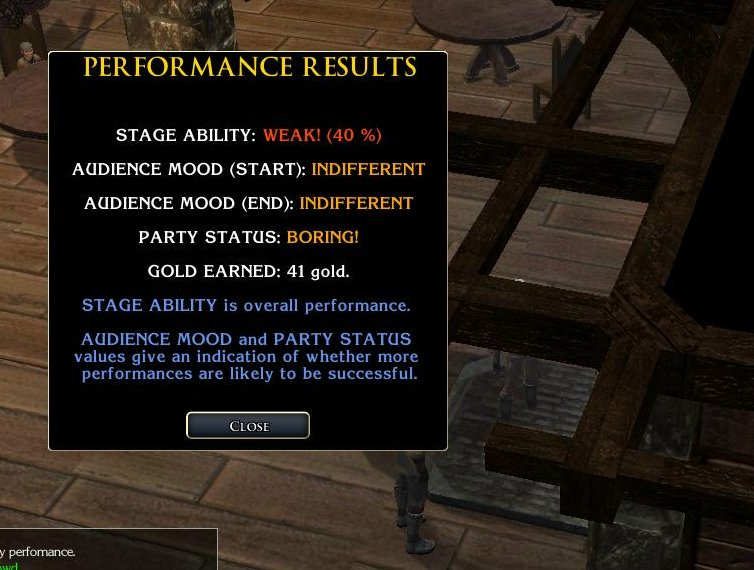
Putting on a performance in a local tavern is one of the new professions that can be used in Better The Demon. Basically, as long as the PC has the perform skill (Bard class), and the local tavern has a stage (most taverns will), then the PC can opt to put on a performance.

The typos in these screenshots have been fixed now.


A performance is judged on a number of factors as well as the perform skill. E.g. a PC can easily overdo an act if they try it too often. However, if they get the balance right, between the number of shows and giving good performances, then they can continue to bring in a wage all the while the audience like their work. A bad performance may mean having to leave it a few days before performing again, while an atrocious performance may lead to a ban from performing at the venue until the performer improves their skill.


The performance results are shown in a new GUI.


The Crooked Path

(Images do not show all options available.)

For those PCs that prefer to let their tongue (communication skills) do the work or their light fingers pick the profits, then there is always the crooked path. The ability to pick the pockets is available to those with the sleight of hand skill and some houses will be suitable for burglary for those with the open locks skill. This line of "work" is obviously frowned upon and affects the alignment of the PC who steals any property. Other skills, such as listen and move silently will also benefit the chances of success for this profession.


Success in this profession will vary according to the PCs skills being used and eventually upon how much wealth there is left to "acquire" this way. After all, a property can only be relieved of its wealth once, and is one reason why a thief may move from place to place.


The biggest risk to this profession is being caught. Often local guards will do random checks on PCs to make sure they are not carrying any illegal booty. If caught, the PC would have to pay a fine and have the goods confiscated or risk a fight to keep hold of their loot. Often, however, a village or town will have a local Thieves Guild where a PC can get the traceable property they have looted laundered. Doing so makes the goods untraceable and not be detected by guard checks.


In the end, however, the amounts of gold to be made with these professions compared to the greater possibilities that come with adventuring will draw the PC away from the general treadmill of everyday work to the darkest depths of some strange land. At the start of their career, however, the relative safety of a simple profession is exactly what they need to keep hunger from the door and have a good night's rest.

Saturday, 3 July 2010

The Main Menu (New Era Mechanics)

It's been a while since I last updated you about the Main Menu that will be available in Better The Demon for players, and so I thought I would post this week about it again. Before I do, however, I can report that this week I have been writing more conversations and correcting code to expand possibilities for player's actions. Wherever possible, I have tried to keep the responses "real" according to NPC motivations and subject to the PC's skills at bluffing, intimidating or using diplomacy. The code correction I mention related to monster drops and now differentiates between bounty item drops and alchemical distillable item drops. The difference being, the former items are always recoverable, whereas the latter items require ranks in the alchemy skill to have any chance of recovering.

The Main Menu

The Main Menu is a GUI that the player uses to play extra mechanics for their PCs in Better The Demon. It can be used as little or as much as the player wants to. It is activated by clicking on the Main Menu button (a newly added feat on entering the game) that has been moved to the quick slots for easier access. (See screenshot.) The Main Menu cannot be accessed during combat.

From the same screenshot, you can also see two other newly added feats/buttons to do with game play in Better The Demon: The Sorry button (used to pacify hostile NPCs who have reacted to a PC attacking them) and the Auto Pause button, used to turn play into a simulated turn-based combat mode, which pauses every six seconds allowing players to determine their PCs actions ahead of time and at a more leisurely pace.

Basic Information: For those who will have seen the last version of the Main Menu, they will see there have been a few changes. First, the menu now has four tabs (this screenshot is currently on the first tab, Basic Information). The renaming of a weapon was incorporated into the new Rename Equipment tab. Secondly, a new combat Auto-Pause option has been added to allow a party of PCs to be automatically paused (and placed into turn-based combat) if attacked and the option is on. Other changes include a Session Time and Total Time for players to note how long they have been playing the module. This page also has the Map Pin buttons and Game Test buttons (when a test is available) and shows the PC's current Vigour level, as well as the Current Game Date.


Rule Information: Accessing the second tab opens up a conversation window at the same time. The conversation window then has a list of options for the player to choose which rule they wish to check on. This Rule Information is given to help clarify the differences in game play in Better The Demon to a normal NWN2 game. The list of rules also updates if and when a player encounters a situation that introduces a new rule. Once a rule is understood, then this section will probably not be visited by the player as much as the others sections. However, some of the information presented here also gives some reference figures that the player may need to refer to now and then. (E.g. Crafting ranks required for working with certain materials.)


Improve Dead Weapon: The third tab relates to a new system used in the Better The Demon: Some weapons, called Dead Weapons, can deteriorate with use. Such weapons can either be maintained by a blacksmith (or PC member with the appropriate skill) at a repair workbench, or, if in the field and far from a workbench, by the use of sacrificing a Life Essence. This function of the Main Menu is where the player can use their PC to repair a Dead Weapon using any Life Essences they might carry.


Rename Equipped Items: The fourth and final tab is used to rename items that the PC can equip. Only items that the PC can equip (and is not stolen) can be renamed. This is just a simple interface to allow players to help personalise their equipment.

If you have any questions or comments you would like to raise about this interface, then please do. Furthermore, if you have any questions about any of the other systems Better The Demon will use, then please let me know in a comment as well.

Poll: Policy Ratio Preference

A reminder ... if you haven't voted in the poll yet (on the left hand side), then please do and feel free to comment.