Choose Your Language

Thursday, 13 July 2023

Episode 76: Stage One!

Readers of this blog may recall a couple of episodes back, that I had determined that this second module of The Scroll campaign, called Predestinated Days, is effectively comprised of three stages. Taking this into account, I determined that I would concentrate on finishing each stage in order, before moving onto the next. This would allow me to beta-test each stage as I continued work on the next. The last couple of months has been about working on "Stage One". Read on...

A Bumpy Start To The Journey

Reaching this point of building module two has only been achieved after a bit of a bumpy ride, due to me continuing to support and update the first module, making it backward compatible with new additions along the way via campaign file restructuring. Thankfully, I believe that long and arduous task is now nearing completion, if not already completed. Apart from some recent last minute pitfalls, (which frustratingly added some potentially game-breaking updates), the first module, The First Day, should now be in its most stable version of release. Therefore, once the latest play-testers have finished their current games, and I fix any last minute issues they might find, I believe the core files for the campaign will have been fully tested in their latest format. As far as I am aware, most, if not all future scripting is now just a matter of writing new scripts, or adding to an existing template; neither of which should interfere with the first module any further.  

Bottom line: Module one should be near enough on its final version, and all updates to campaign code are now written within their own boundaries for the later modules. Hopefully, readers will recognise this as a big step forward for both the stability of module one, and how it will help expedite the writing of module two. I would like to take this opportunity to thank all those who have supported me and been patient to bear with me with the many updates through the growing pains of the campaign. Hopefully, the end results were, and will be, worth it.

Stage One Progress

The New Quests

As I look within the toolset and at the numerous quests available for Stage One of the second module, I can see, at a glance, that five entries still require their journal end-points to be completed. However, I am also aware of a sixth journal entry, which has some missing entries that requires completing. I also note that this first stage has the most journal entries of all the three stages of this second module; although I appreciate that this does not necessarily reflect overall play duration, due to some quests possibly being quicker to complete than others. (Please note that I will cover the completion progress of later stage quests in another dedicated post for that stage.)

In the last month, I managed to reach (and add) another "end-point" to one of the larger side scenarios that can be played. All that remains to be done for this scenario, are a couple of conversations and the placement of some plot items. The point I am trying to make, however, is that the main framework for this latest quest is now complete.  For the record, it's worth pointing out that this is one of those quests that does not have to be played within the modules first stage, but, for the purposes of setting myself a completion goal, I have included it in "Stage One" as one of those to work on first.

Of the other entries that remain, one is the path of the main quest, which is a conversion of an old pen and paper scenario that I designed way back in the 1980's. I am hoping that it should not take too long to convert, although I have been adding some other gameplay details to it along the way, so that it reflects the flavour that players would have normally picked up when playing with a DM who would have given more feedback information at the time of play. I am also hoping to add one or two other gameplay aspects to this quest, which work better in a computer environment compared to how it was originally designed to be played in pen and paper. Finishing this quest alone would take care of at least two journal entries that currently remain. This will be the next area for me to concentrate on after I finish the final details of the one I am currently finishing off.

Lastly, there are around four other journal entries that are closely linked to one another, which the heroes will have the opportunity to deal with during this stage of the game. The core outline for these remaining quests is already set in place, but there are one or two conversations that require extra attention due to the logical flow that is involved during the process of completing these related quests. For while I could simplify (and speed up) the whole process, it would be at the cost of some unique gameplay. For me, such a design is the difference between a standard RPG quest experience and one that a player feels is tailored to their own unique gaming experience. If I can achieve this, then it will, hopefully, give a player a unique feel for their game, and the possibility of a different outcome and experience if ever played again.

The New Puzzles

Alongside some of the puzzles that came with the first module, I have introduced some new ones. Some are repeatable (in a similar fashion to the tumbler chest puzzles), but others have been designed to complement the current scenario. This first stage of the second module comes with at least one of these newer puzzles, which is designed in a way that I hope will keep the player intrigued and wanting to push forward in their current quest. In this sense, I have designed the "puzzle" to be part of the adventure. Hopefully, you will understand what I mean by this if and when you have the opportunity to play it.

Regular readers of this blog will know that I enjoy games that include puzzles or mini-games, which are employed in such a way that can add an enjoyable addition to the gameplay. In this second (and third module), I am trying to add some new gameplay that I hope will give players something extra to test both their wits and tactics, while having fun at the same time. I think of the times when, as a DM, I would present a puzzle to my group of players and have them try to figure out what part it has to play at that time, or how it may be of importance moving forward. In my mind, it adds another dimension to the gameplay, which I hope adds an interest and further expectations a player may have.

The New Gameplay

When we look at the AAA games available to play today, at first it may seem like anything we might try to make with NWN2 will appear to fall far short from that which is currently on offer in such new games. However, I have come to recognise that the enjoyment of a game is not just about such things as the introduction of a fancy new graphics engine, but just as much to do with being something "new" in general. The real enjoyment is to be had when a player can relate to a story being told, and has a good understanding of their ability (through their avatar) to be able to participate within it. If, along the way, they learn or experience something new or interesting from what they have experienced before, then that new moment of discovery or achievement is what has the player keep coming back for more.

The fun, as I have come to understand it from my own experience, is in the discovery of something new about the story or game I am playing, which I can then respond to or work with. Conversely, if the story or gaming element is something already (or becomes) too familiar to me, then that is when a game can fall flat, and possibly abandoned. Therefore, even though NWN2 may be considered an "old" platform, I concluded that the story I am writing for the game is still worth telling using it. For while I believe "there is nothing new under the sun", I would, however, like to believe that this story (of my own telling), can still offer some players "pause for thought", and hopefully remain as a memory of a pleasurable experience long after they reach its finale.

I would like to add that my knowledge of using the NWN2 toolset has improved over the years. Unfortunately, this is not in the ability to design new areas with grand and magnificent vistas, but is instead, in an ability (I hope), to give some unexpected designs in gameplay that may surprise the player and give them a moment of experiencing something "new" within the NWN2 gaming platform. I can think of at least two places where the end results of what I was trying to achieve exceeded my own expectations when play tested in-game. Maybe I am easily pleased? The point I am trying to make, however, is that the next module (at least), will come with some new gameplay experiences in the form of some interesting and unexpected differences from the standard NWN2 game that players have come to expect. This is the excitement of playing a modders game, as you never know if the builder has added something new to what is expected from the standard game. In this sense, we can have both the experience of playing a game that we know and love with the added excitement of not knowing what the builder may have in store for us.

Today I can report that Stage One of the second module is one step closer to a point of "completion", at which point I can then pass it on for testing. For now, here is a screenshot from Stage One of module:
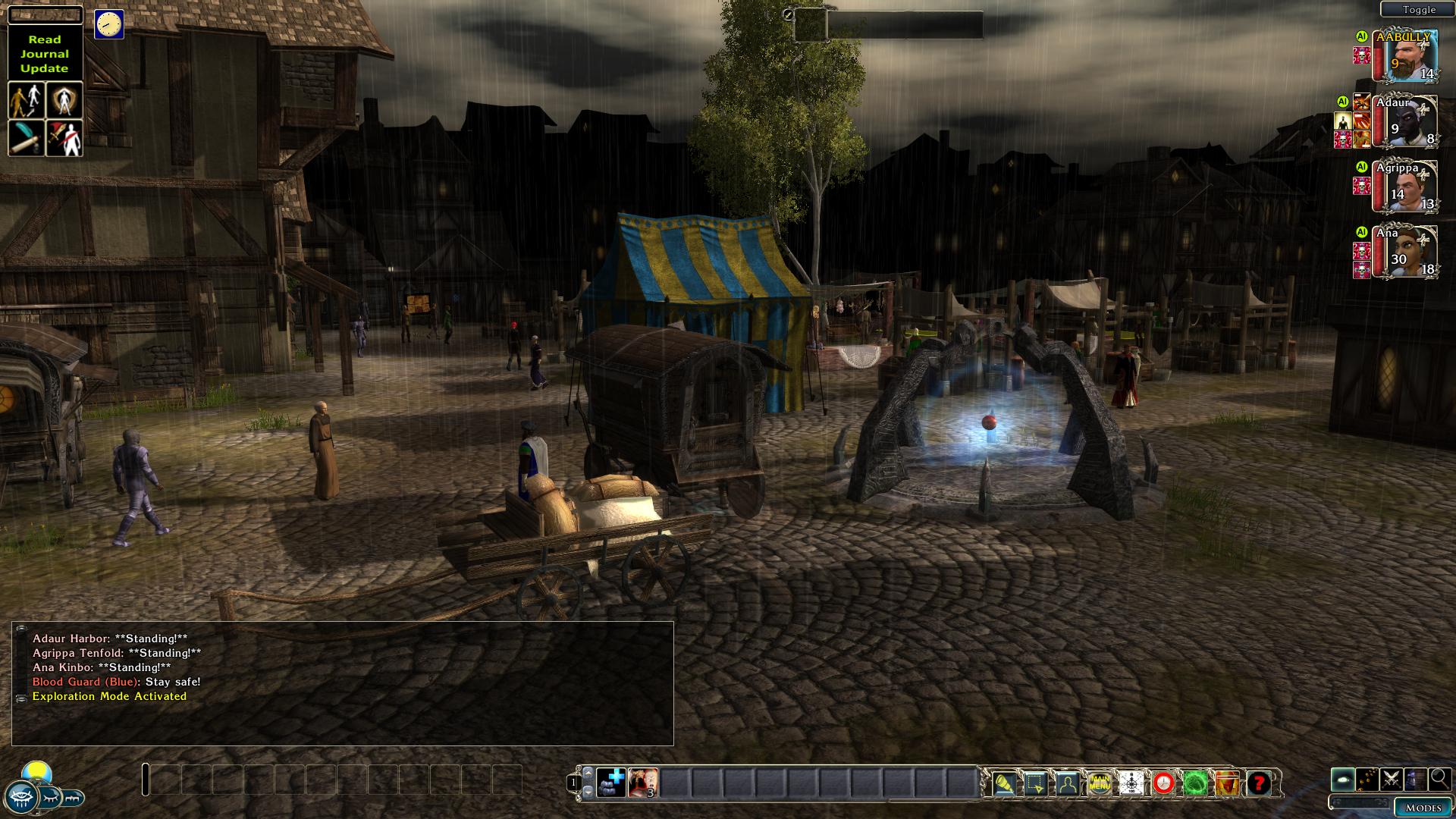
Another Time & Another Place!


Friday, 9 June 2023

Episode 75: Objectively Bigger!

Just over four years ago I made my first episode post reporting on the current development of The Scroll: Predestinated Days, my second module for my NWN2 campaign, called The Althéa Campaign. Today, I can report that this second module is now "objectively bigger" than the first, as over the last month I have managed to add a few more quests that now give this second module more quests than the first has. It's not that I ever set out with any particular number of quests in mind, but that's how it has ended up... and there's still a possibility for a few more to be added! Now, I don't want to say much more about the numbers specifically, but I do want to reassure readers that I believe I have hopefully not compromised on quality.

Regarding The Quality

I guess we have all heard the saying that "bigger does not always mean better", and, I agree. That said, I hope the time I have spent in the toolset and supporting my first module, The Scroll: The First Day, has gone some way to helping me be able to develop a second module of a quality that, I believe, is actually better than the first. There are now a number of points that I would like to share that I hope will make this second module a game to be remembered.

1) A Larger Environment

Having broken free of the barrier surrounding New Edgeton in the first module, the heroes are now free to explore the open world around them. This means the second module will open with a world map. However, those that have played my first module may recall that there were actually two world maps available! So, not only will the second module come with two world maps with various locations to explore as they discover them, but the first world map will also be supported by an overland map.

For those that are not familiar with the technical differences of these map types, basically, an overland map is a closer expanded region of a world map, but works in three dimensions, like an area map, albeit on a larger scale and with a fixed perspective. It acts as a good midway system to allow a player to move their party large distances while allowing further interactions as they travel. A world map, by comparison, is just a pictorial map that a player can select locations to travel to without any further input required from the player. I would add that the the term "world map" is a misnomer, as each such pictorial map actually only represents a section of the world as a whole. Just like most RPGs, they simply represent sections of the world where the current adventure takes place.

2) Story Progression

Finally freed from the confines of their home village, the heroes can now learn more about their role in it. Note that if the player has already played the first module with Option One background, then they will already have some knowledge of their role in the events that are unfolding. However, as many players will more likely have selected the Option Two background, then this will be the first time they will be introduced to the campaign events that have been occurring while they had been trapped in the village. However, whichever background the player has chosen, the story will take a large step forward in this module. Furthermore, if a player has not played the first module, they will still be given the choice to select the background option and be able to continue the story.

In the first module, the main plot line (reference the cutscene as the PC enters the village for the first time), had to take a back seat as the heroes were forced to resolve the village's barrier issue. In the second module, however, it does not take long before the heroes find themselves embroiled in those events that they had consciously known little about. Not before long, they will learn of things that had remained a bit of a mystery from the first module, and start to recognise the world just got bigger! And so has their story!

3) The Quests

With a larger environment to explore there comes more opportunity for adventures anew. However, I want to remind readers and players alike that I like to design this campaign from the perspective of a pen and paper D&D style adventure. That means, most quests will be focussed affairs that could stand alone as a full blown adventure with areas and mysteries of its own. Furthermore, those quests that would be considered main quests may intertwine with one another in such a way that, arguably, various quests may string together as if each was the main quest as it happens. The difficulty I have as a builder, is designing these quests to work together as a whole for all possible directions every player may execute their version of the story.

Similar to the first module, there will be quests that suddenly open up into adventures more complex than first expected. However, I am hoping the second module manages to do this to a greater effect and with a more satisfying result. Also, because I am using adventures converted from my pen and paper days, I am hoping the atmosphere and gameplay of these quests will be more immersive than most.

Technical Improvements

From past experiences, I have managed to improve some of the ways cutscenes are handled and even have picked up one or two tricks that I have not seen used in any other module to date. They have involved more scripting and preparation than most events the player may normally encounter, but there inclusion is, for me at least, one of the most exciting things I am looking forward to the player experiencing. It is these particular details that I am finding the hardest not to talk about, as I don't want to spoil the moment the player experiences them in game. I am hoping for a "Wow, that was cool" or maybe even, "I did not know this game could do that" kind of reactions. Admittedly, modern games may do the kind of thing I speak of, but I hope it will come as a pleasant surprise for people used to playing NWN2 modules.

Another more obvious technical change will come later in the module, where I introduce another whole layer of gameplay for the player. I like to include new experiences for players of my modules, not just in the way of a story, but in the way the game can be played. Note, this new level of gameplay plays alongside what the player is used to, but, hopefully, will add a level of interest that has the player wanting to progress in other ways. It involves new GUIs and interaction in ways that suits the environment and story at that stage. In some sense, it is an entirely new module within the module, and one that alters the pace and atmosphere of the areas involved.

A couple of last points I want to remind readers and players alike, is that all these adventures and exciting new gameplay is being designed with the player's choice of PC character backgrounds, meaning conversations will offer more variations when employed, and that the whole experience is also still being designed with coop MP in mind, so the module will also be able to be played with a friend or two, as well as the standard SP option.

Bigger Is Better!?

An Ancient Sacred Site

Monday, 8 May 2023

Episode 74: The Three Stages!

Apart from running into a handful of strange scripting situations over the last month, I did also manage to make some progress with the second module. As I pondered what remained to be done, I realised this time around that the module will play out over three stages. Let's now take a look at how things currently stand.

Scripting Weirdness

To begin with, I just wanted to note (for the record) that I have had one or two strange issues of late, which, on the surface of it, appear to be related to scripting. First, my escape key appears to randomly stop working in game now and then. Secondly, I have had scripts that should work fail. E.g. I have a script that randomly fails on an object that works fine on other instances of the same object. Thirdly, I have had a couple of scripts that failed to work, only to suddenly start working! So, either I am going through a particularly bad month for concentration and bodged something somewhere (which is quite possible), or my computer is playing up (I have had a couple of other minor issues outside the toolset), or lastly, NWN2 is giving me a bit of a runaround of late. I'll keep an eye open for these moving forward, and update readers if I can ever explain any of these.

The Three Stages

The above issues aside, I have still been making gradual progress with the second module. It was while I was reviewing what remained to be done that I realised that this second module could, arguably, be split into three stages, or chapters. For my own design purposes, I won't be using chapter denotations. Notably, however, now that the three stages have become clear to me, it does mean I can concentrate on finishing the first stage, to allow my wife to alpha test that part while I continue to work the on later stages.

The Beginning (Stage 1):  

As to be expected, the first stage of this second module takes place immediately after the player finishes The First Day, the first module in my NWN2 campaign, The Scroll. Subject to how the player starts their game, however, determines how this second module opens. Ultimately, however, the PC begins their journey into the lands beyond their home village, New Edgeton, from which they finally managed to escape in the first module.

This first stage still requires finishing the overland map and some new areas recently added to it. It was as a result of comparing this first stage to the latter two, that I realised it lacked one or two events required to balance it compared to the module's later stages. The decision to expand this first stage has turned out to be a bonus, however, as it meant I could expand the story slightly and add some gaming elements, while redressing the weight of the overall adventure at the same time. As I mention above, it meant I had to add a few more areas, which added time. However, to prevent too much time spent on further development, I made the decision to grab some pre-fab areas (or some of those areas designed by other builders), to rework for my module needs. I still needed to design one interior area, but this area is nearly finished now. I currently continue to concentrate on getting this stage complete.

The Journey (Stage 2): 

While even the beginning stage requires the PC to explore their immediate surroundings, and travel across many miles, the world (and current adventure) does not, and will not, end there. In the gameplay of stage one, the PC will learn more about the world and their role in it. This eventually leads the player to recognise they need to head farther afield to where stage two takes place.

I don't want to give any spoilers, but suffice to say, the PC now enters a new region with new adventures and experiences as they continue with their overall goal they learned in stage one. This second stage is already well fleshed out with areas and quests, and apart from finishing a couple of larger quests, is mostly done.

The Ending (Stage 3): 

Eventually, there comes a point that is reached that clearly denotes the beginning of the second module's third and final end stage. Note, however, that just because the PC begins this third and final stage, it does not mean that the PC will not have further dealings with any previous stages of the module.

Of all the stages, this third stage is still the one that requires the most work, as it is also the section that introduces a unique game-play system. The core of this system is already setup, but its execution still requires some careful attention. Suffice to say, I am hoping it will add a whole new level of interest and challenge for the player by the time their PC reaches this third stage of the module.

Stages Moving Forward

The point I am trying to make is that each stage of this second module can be defined clearly from the point of view of work outstanding and, more importantly, when it can be given access to testing. What this now means is that I finally have a plan of action to help bring this module to completion. My aim is to try to concentrate on each stage starting from the first and ending with the last, in order, so I can have each stage alpha-tested as I work on the next. As soon as I have each stage finished to testing point, I'll hand it over to my wife to test and let readers of this blog know.

And to mark this stage of development, and with three being the theme, here are three screenshots from the stage I am currently working on:

Is there A Swamp Monster Here?

Yes! There Is!

A Puzzle Perhaps?

Tuesday, 11 April 2023

Episode 73: Upping The Ante!

With a new module comes new challenges... It's a time to "up the ante", and to introduce new monsters and puzzles for the party of heroes to face and overcome. However, creating such new challenges for the player's band of heroes also translates into creating new obstacles for the builder to overcome. Let me explain ...

New Monsters!

It is said that there is actually "nothing new under the sun" (Ecclesiastes 1:9 KJV), which is something I happen to agree with. However, for each of us, there are certainly new things to experience, even if it has been around before in one format or another. I mean I believe it is safe to say that most of us know what a vampire is, and what to expect it to be like, but... It's true to say that not all vampires (and any creature for that matter) fall from the same mould. Yet, it is these small variations in the monster template that can make the encounter a bit more "exciting", or perhaps I should say "dangerous", upon encountering one such creature in a new campaign world.

This is because not every builder will include certain aspects of a creature's design in their specific version of the creature in question. Sometimes this is due to the limitations of the NWN game engine that we use, or more likely most of the time, due to lack of time to script in all those lovely AI updates we could employ for the various creatures. That said, when we have been able to add a slight nuance to a creature that may not have been experienced before, it can add another level of depth to the module being played in question. Therefore, with this in mind, I hope, on the odd occasion, to add just a little bit more to any new creatures encountered in module two. Let me be clear on this matter, it will only be the odd one or two, as some creature variants can be quite complex. One such creature to have undergone such treatment is in this week's screenshot (see below).

My normal approach when dealing with this sort of thing, is to gather as much information about the creature I have in mind to use as possible, and then create a version that supports as many of its known features as possible. This is where the "ante" builds up for me, as even adding just one unique property for a creature takes time. If a creature has two or three properties that differ from the original template provided, then it takes me longer to include them in the final build. The end result, however, is a more rounded adversary, which, I hope, will also "up the ante" for their encounter. Whether players will thank me for that, I'm not so sure. I guess time will tell.

New Puzzles!

I've reported on these before, but I would like to touch on them again. For The Althéa Campaign, puzzles range from simple mini-games to more complex situational puzzles. Those that have played my first module will be quite familiar with the mini-puzzles I refer to, and so hopefully, will feel quite a home with the new variants that come with Predestinated Days, my second module. These sorts of puzzles can occur multiple times through the adventure, and can normally be solved in various ways. That said, I am making a concerted effort with this second module to expand on the more elaborate situational puzzles.

Again, players of my first module will be familiar with the sort of thing I mean. However, when it comes to these "situational" puzzles, I have decided to try to "up the ante" in these too. By "situational" puzzle, I mean those that PCs can encounter in an area rather than on any one specific object. I consider them multi-object puzzles, which a player may need to take notes on, or, more importantly, consider a bigger picture when working with them. One such example from module one, was repairing the sewer units. Here, the player had to understand a process and consider the long term goal or what it was they were trying to achieve. It is this kind of "puzzle" or "task" I hope to take to a new level of interest or, from my perspective, presentation. It's currently an idea in progress, but I already have a couple of these task-like puzzles in place, and I think they play quite well ... I just hope players think the same.

More Challenging!

Basically, as to be expected for an experienced party, I guess, the next module is aiming to be more of a challenge for both the heroes and by default, the player too. That said, I aim to try to include the normal alternative ways of playing in place, to allow players a different approach if they struggle to progress, even if it means altering the game difficulty setting, or a frugal use of Life Essences at the right time.

Perhaps A Little Too Challenging, Alone?


Friday, 10 March 2023

Episode 72: Forging Your Own Path!

There may be one overarching story in a module or campaign, but the journey, or path, you take along the way is what makes the adventure unique to you. Designing a campaign that can be approached in a number of different ways was one of my main objectives, and the second module of the series, Predestinated Days, continues with the same approach. So, whether you decide to play it with a bunch of fighters, a small band of thieves, or even a holy or unholy brotherhood of clerics, that is just the beginning of your choice of adventure. Let's take a closer look at some of the latest progress for the next step along the path of the Althéa Campaign.

The Alignment Path

A PC's alignment plays a big part while exploring the World of Althéa, and so playing a holy warrior, like a paladin, may not necessarily be an easy path to tread. The same can be said of good or evil aligned clerics, of course, but also includes other classes that rely on following a specific alignment, like that of a druid or a bard. The point is, when selecting a class that relies on an alignment to stay true to the class specifics, the player should realise that they will have already bound themselves to consider their actions they take in the campaign moving forward. Shift too far from the class alignment reliance, and they may quickly find themselves a fallen paladin, or too far removed from their class requirement to continue in the chosen class. Through their actions, a PC could find they are drifting too far from their class alignment requirement and so need to take steps to redress it before they lose their class status.

The Althéa Campaign does its best to accommodate such PC actions, and while not perfect, I believe it still provides a workable framework for any class to be able to progress, if the player observes this while playing. For instance, it should soon become obvious that killing creatures can shift alignments (in either direction), and actions such as stealing, and chaotic behaviour, such as destroying property belonging to someone else, will also cause alignment shifts, as just a few examples.

But what happens if a PC has a bad day, and events appear to have conspired against them and they find themselves feeling a little off course to their intended behaviour? What happens if a druid is forced to kill an evil creature in self-defence, which ends up being recognised as a good act that has now shifted their alignment to such an extent that they are now considered a hero for the people? "He's such a good chap", the villagers start to cry! Not what the neutral-bent druid needs at all! Well, in the Althéa Campaign, there are a number of ways a PC can repair any life altering alignment swings, deliberate or otherwise, by reconsidering their PC's actions and actively doing things that may redress this balance (if possible) ... or by making an offering at an altar.

To do this, a PC must locate one of three types of altars that can be found dedicated to the various gods throughout the world, dedicated to either: good, evil or neutral. They perform in a similar fashion, but to avoid spoilers, I will only speak about the impact on the alignment, the subject of this topic. Making a valid offering on a good or evil altar will help shift a PCs alignment according to the altar's persuasion. A neutral altar, because of its very nature, does not apply any alignment shifting. The PC should experiment with the offerings they make, but if they do it correctly, then the PC's alignment (and all party members currently associated with them) will be shifted in the direction that the altar represents. I hope I need not say how care should be taken if there are those in the party who would not appreciate such alterations to their own alignments. It should also be pointed out that destroying one of these altars affects alignment as well ... in an obvious way, I hope.

Alignment play in action: If you would like to see a player called Travus playing a paladin (with a related good aligned party) in the campaign, take a look at his videos of playing The First Day (the first module of the campaign) ... and be sure to leave a "like" for him.

The Quests Path

In the Althéa Campaign, just as important as alignment choices, are the quests you choose to play, and in which order ... as each choice can affect the story for you, elsewhere. For this reason, I do not think some of the terms used to describe cRPGs in general suit my campaign design. For while it has some elements of those types of labels such as "story" or "sandbox", I don't think either of those two labels describe its design sufficiently. If I was to be so bold, I would like to add my own design label to suggest a gaming style called "Story Maker", where the player is creating the story around their PC, dependant upon what they choose to do. That is, it is designed like a D&D PnP campaign, with options that a player can, in many cases, choose to follow up upon or ignore completely, which can then impact the overall game experience. Or, to put it another way, the design is a "story" made up of different "sandbox" type elements. That is to say, the campaign is following a main story, but also allows the player to explore the world freely (similar to a sandbox design) in the hope to find other adventure. I guess the distinction is subtle, but I hope anyone who plays my campaign will be able to appreciate this difference I am trying to express.

So how does this play out in the game? Well, as an example, the campaign is designed with some scenarios (to borrow a D&D term), which some players may completely miss if they choose to ignore certain leads in the game. By the term "scenario", I am using it in the sense of a full adventure in its own right, and not just a basic side-quest. Building a campaign, is effectively a world full of different adventures, waiting for a player to discover and then to decide whether to pursue them or not ... and if they do so, in which order? The point being, one player may approach the story from one angle (or adventure), while another player does so another way. The full story is made according to their PC actions.

As an example from my first module, the hero can explore the village of New Edgeton, discover a sewer entrance and immediately choose to explore it. Alternatively, they could just ignore it. Later, they find a notice that leads them to consider asking about work in the sewers. The hero could pursue this, or ignore it. Later, the hero may hear of people going missing in the sewers, or that there is a reward for carrying out a task in the sewers. The hero could pursue any or none of these leads. After all, the main story (for the first module) is about removing the barrier from the village! Whether the player decides to follow up on any of these other worldly events is left entirely up to the player. These are "story elements" unique to this player's PC's experience. NB: The campaign has its own main story arc.

Finding Your Path

Why does this matter? Because, as my design ethos dictates, what you do in my first module affects what happens in the second, which is what I really want to talk about now. While it is possible to start afresh from my second module Predestinated Days, I am hoping there will be players who have managed to play my first module, and have access to a PC they played in that module, or even still have a saved game that can be continued from.

The point is, the second module, being a part of the campaign as a whole (of course), is set to continue on the same design style of giving the player the choice to pursue as many of the other world events they may discover as they would like to. Just like the first module, (and all modules with a main story), some quests must be completed to reach the end game. However, there will also be areas designed for the player to explore just because they are there. Importantly, these will come with their own adventures, and not just be infill areas on the way to complete the main quest. Outside the main quest line, I leave it to the player to decide what gaming elements they wish to pursue, but try to encourage the player to explore and build their own story from the world I have created for them to explore and adventure within.

So, as a final point for now, here is a screen shot from an area I have been working on of late, which only the most ardent or curious adventurer might find. It is full of mystery, quite dangerous, and possibly one such adventure that they wish they had never stumbled upon ... but, hey, isn't that what adventures do all the time?


Through The Trees, You See A House In The Distance!

Saturday, 4 February 2023

Episode 71: The Warts and All!

It was Oliver Cromwell, the devout puritan, who first coined the phrase that we still use today, when he said that his portrait must be painted showing his "warts and all". I carefully use the term now to say that my own module, The Scroll, can now be seen being played in its latest form to date. This public viewing of the module is being played by Travus, who, in my opinion, is an expert player. He is doing a great job of putting the module through its paces and revealing both the module's strengths, and, of course, the occasional "warts" that may still need addressing. Let's take a look at the latest ...

WARNING: Potential Spoilers!

Now, if you hope to play my module at any time, then you may wish to avoid taking a look at these videos beyond the first two, as the path you take may be very different to that which Travus has taken. In fact, arguably, even the first video has Travus taking a potential different path to that I have known other player's to take. However, Travus prepares his videos so well, that they are a delight to watch. His voice acting brings both the PCs and NPCs to life, and he gives great consideration to all the actions he takes. Put succinctly, he is the exact type of player I appreciate, and one I hope is enjoying playing my module as much as my wife and I are enjoying watching his play through of it.

Warning aside, if you want to see how Travus is doing, and don't mind seeing potential plot lines that would differ from your own choices, then do take a look at his videos and be sure to "like" his work. Maybe it will encourage you to take a closer look at the module yourself? After all, I have confessed in the past that The Scroll is not for the casual player, and requires a player's time investment to fully appreciate. Travus demonstrates exactly how to approach the module, and hopefully, seeing some of the gameplay in action by someone who knows what is required will be helpful and encouraging to watch.

So, if you are interested, here is the link to the list of videos at the excellent AhTravesty YouTube site, which have been released and are available to date. I believe Travus is aiming to release a new episode every other day; so be sure to come back and keep up to date if watching.

Warts Being Removed!

If you take a look at the videos, just bear in mind that any "warts" (that is "bugs"), that you may witness in any of them will have been removed already, or will be removed as soon as I can do so. A few minor typos and grammatical errors will likely still remain, but with the help of another tester, Dustin, I am aiming to address as many of these as I can over the weeks or months ahead too. The most important gaming bugs, however, reported by any testers, will be addressed as soon as I can, and an update released for all players and testers alike. So far, all the latest updates have only needed to address a few minor glitches, and have actually better served to add new content rather than address any severe bug. For example, the latest update (v1.94E) adds improvements to the familiar GUI. (See screenshot below.)

Module Two News!

Again, I want to assure everyone that the second module for the campaign is still in development. Importantly, please remember that any bug fixes for the first module, and any new content that gets added to it is also an update and progress for the second module. Therefore, if you are a player who ends up playing and enjoying my first module, and have something you would like to see in module two, then do let me know. As an example, the improved inventory and familiar GUIs were as a result of watching Travus's style of play in his videos.

TWO NEW AREAS: I am currently working on a plot that involves vampires, which regular readers of this blog will already know to expect in the next module. It was while working on this quest that I realised I was going to need a couple more areas, again! These have now been created, and I am writing new conversation lines based upon the plot that involves these two new areas.

Again, I am very excited to report that I believe I have come up with an interesting plot line that will have the player wondering what may be transpiring, before solving the mystery involved. Of late, I have been quite determined to add an extra step of wonder (that I hope won't confuse the player at the time), which may help to make the quest a memorable one. Sorry that I cannot go into more detail.

Moving forward, I hope to have this quest finished by the next blog release, and, hopefully, I will be able to update you on what I move onto by then. Apart from addressing any "warts" of module one that any of the testers or players bring me, it will most likely involve writing more conversations. 

Until next time, maybe watch a video or two, or leave some comments. Feedback is what helps move a project forward.

Aeriol Choosing A Familiar!

Friday, 13 January 2023

Episode 70: Let's Go Exploring!

At the end of last year, I was able to wrap up one of the side quests for my second module, Predestinated Days, just in time for me to pick up another to continue working on at the start of this new year. This quest I am considering now, however, is set a little out of the way. Not only that, but it involves its own backstory, with NPCs doing their own thing, and which the heroes may somehow discover. If you are interested in reading about the latest development, especially in the steps involved for a builder, or hoping to pick up a hint of what to expect in the next module, let's go exploring.

Step One: Acquiring The Quest!

Every good gamer knows that before they can reap the rewards of their various adventures, they need to find a quest that may offer such in the first place! For the adventure creator, this can be a challenge, because, unless we care little about quest delivery, we often prefer to gently guide a player into a place where it feels natural for them to take on the adventure rather than railroad them into it.

However, unless it is a story driven module only, we are also aware that the gamer plays our modules so they can do quests in the first place. Therefore, of all the stages of quest development, this step is probably where the builder can cut themselves a little slack when it comes to creating the quest. For myself, I use a number of quest delivery systems, from conversations, reading notices, or finding items, to name just a few. Personally, I try to avoid "repetitive" tasks (or quests) where possible. Therefore, any task I design will normally only be "achievable" the once, but may or may not be time restricted. 

The main aim for me when introducing a player to a quest is to give them the feeling of ownership rather than a requirement. In a story driven module (or campaign), however, it is impossible to avoid certain quests that require finishing ... but, if we can add more story elements that allow various completion paths, or that may become part of the main story in some way, then we can offer a unique experience for each player who plays the module. This latest quest I am working on is one such story element I am hoping will potentially add some unique experiences for the player.

Step Two: Reaching Our Goal!

Normally, most quests, once acquired, require some preparation on the part of the heroes before they head out to do the actual quest. If the quest is a simple one, like having to speak with somebody or fetch an item, the amount of preparation may be minimal. However, this is also an area where the builder can throw in a curveball to catch out unprepared players. This should not be overused, of course, but it is a good way to have the heroes suddenly find themselves involved in a larger quest than first expected.

In the quest I am currently working on, some of the opening steps are about 'info gathering' before coming to the conclusion that the heroes need to travel to a location farther afield. This had me looking at the map systems again, and, for this quest in particular, looking at the overland map that will come with Predestinated Days. Having done their 'homework', the heroes will learn they must travel to a certain location, and this is where the new overland map comes into play.

This week's screenshot shows the new look for the overland map. On it you can see the new "Travel Information" at the top of the screen. This information takes into account all pertinent figures regarding the whole party and their travel situation, including: 'Current Terrain', 'Speed' and 'Distance Travelled', as well as who in the current party of travellers is best (according to the PCs skills) at 'Detecting' objects and creatures, and/or 'Protecting' the heroes from possible dangers. There is also a line of information saying whether the heroes are using basic rations or have a cleric that is using Create Food and Water to enable them to travel. All these figures update live, and the overland map supports all the other objects a player would expect to see in such a setup, including finding hidden objects or locations, as well as having encounters!

Step Three: Completing The Objective!

So having reached our 'goal', we now have to determine what we need to do to complete the objective. However, this stage can also include extra info gathering and preparation, as in steps one and two above. That is, we may have additional steps that need to be considered before we can achieve our final mission objective. It's akin to discovering a new area that has its own requirements to be met before being able to reach the final objective within the area. This, of course, can continue for as many times as you have the time to develop this particular story line.

I know I am describing what most players and builders will already instinctively know, but sometimes it is worth considering some of these steps more carefully before moving forward to the next ... too soon. In a story driven adventure, we aim to avoid the formulaic 'pick up quest', 'reach quest', 'do quest' which use as few details as possible, as that will only make the 'adventure' feel weak or quickly forgettable. In The Althéa Campaign, my aim is to reproduce the feel of adventuring and world exploring rather than be forced to follow a single story. That is to say, the campaign, while having a main story to follow, it is not the sole reason for a player playing a PC in the world. The world is bigger than the main story, even if the main story is the greater part of the module.

So, back to the quest I am working on, and how it fits in with the rest of the campaign. First, it has connections with the first module, The First Day, and so has a sense of continuity for players who played the first module. Secondly, it takes part in a section of the world that may otherwise be overlooked if the heroes choose only to follow the main quest. Note, it is this latter point that makes this project I am working on a campaign rather than a module. There is a subtle difference between what a cRPG (computer role-play game) calls a side-quest and what in PnP (pen and paper) one would call a scenario. My aim, especially in this second module of the campaign, is to try to provide one or two larger scenario type 'side-quests'; this being one. Such scenarios take more time to build, however, and so even incorporating just a few can be a challenge.

Step Four: Mission Accomplished!

Only after the heroes have overcome all the obstacles on their trek to reach and achieve the final goal, can they at last say that they have accomplished their mission. However, hopefully, the journey to this accomplishment will be one to remember rather than anything quickly forgotten. The quest may have opened as a mystery before some information was learned, a path trodden, and some creatures defeated along the way. But, the flavour or story behind this quest will, hopefully, have one or two elements that make it stand out from the crowd, which in turn, may also help to give value to any reward the PCs finally receive. In particular, the heroes actions may well have served to change another aspect of the world in which they travel, while always still on the course to save it from a yet far worse pending threat.

The point is to give a sense of achievement whenever possible, without overplaying or underplaying each stage. If the task has been more basic, but a part of the background story nonetheless, then it should be recognised as good role-play by the player and rewarded for such appropriately. In other words, when a PC agrees to collect ten items for a local mage, the reward should not be the greatest sword ever made, (unless you have a good plot reason for doing so), but be rewarded appropriately. After all, the PCs have still made some sort of progress. The point is to try to balance the number of 'basic' tasks with more meaningful scenario type quests, in such a way that they complement each other in a style that awards satisfaction in proportion to the quest's difficulty. Each should reward the player in a way that befits the effort involved.

Step Five: Thanks For The Memory!

In the case of the scenario I am currently writing, it opens with a missing person, involves some investigation, some risk taking, some travel, and eventually the discovery of new areas, for which the attentive player will have prepared their PCs for any potential combat ahead. 

That's the outline for this scenario, and the final confrontation is already prepared. The front end is completed, and the final rewards are in place, should the heroes succeed in their task. All the areas are designed, and all that remains is to add the final details that I hope will make this diversion a memorable one. Now, whether that is a good or bad memory may not be just up to me, but how the heroes adventures fare in this place. Good adventuring, heroes!

Roaming The World At Last!

Saturday, 10 December 2022

Episode 69: The Long Journey!

As we approach the end of yet another year of module writing, I end it looking forward with eager anticipation and hope that the next module, Predestinated Days, will see a release some time later next year ... more likely towards the end of it! For now, this is going to be a relatively short blog this month, with just a few notes of what I've managed to do this year, and where I hope to be heading next year. Writing Predestinated Days has certainly been a long journey, even up to now ...

That Which Is Done!

The start of this year saw me turning to some of my old pen and paper (PnP) scenarios with a view to bring them to NWN2. In the last year I have successfully managed to incorporate one side quest, which turned out far more involved than I first thought it would be, and have the foundations of two more core dungeons laid out.

Later, I delved into developing some rotating puzzles for my mega-dungeon, which was first started around July 2019. Work on this mega-dungeon has been continuing back and forth as I come up with more ideas with which to fill it and make better use of its size. Importantly, I have also developed a number of new gaming systems for that dungeon, which I hope will all add to a very exciting experience alongside the normal fun of deep dungeon delving.

Another area I have worked on has included new creature AI, including vampires with gaseous form and their coffins; lycanthropy and its curse (and curing), and the ankheg and its spit! Each of these creatures has its own areas of interest, which I have also been developing alongside the creature itself.

Later in the year, I realised that the scale of the world had grown larger than I first realised it was going to, and so I had to start bringing in more areas, which meant I also needed to consider new quests. Using NPCs that I had from my PnP days that fitted the bill, I wrote some new side quests, which has taken a large amount of my time over the last six months that had not been expected. These, however, are now done, mostly.

By now, my coding skills had improved from a year or two back, and I started to rework some of the earlier code, including improving shop vendor response interaction, conversation background options, journal updates and even write a small card game. Some of these updates I made backward compatible and released v1.50E (onwards), which supported the improved game mechanics. Other code, like the card game, will be included as a new experience in the next module, Predestinated Days.

As this year draws to an end, I find in the last few months I have been bringing together some of those more difficult plot lines that are brought in from the first module, The First Day, and that now come together for the two background choices within this second module. Basically, the core plot line has now been solidified for both backgrounds, meaning journal entries moving forward will no longer have to consider the difference in background choices.

That Which Is To Come!

Moving forward is primarily about continued development of conversations and quests. Many of the side quests (that I have started) are now done. That's not to say that I may have another idea or two for other side quests that may present themselves to me as I move forward. Around three small side quests remain to be written, with a couple more larger ones that mainly require dungeon design and monster balancing, as well as any puzzles or literature I may decide to include.

As far as the main quest goes, I have now structured it in such a way that it has its own number of "side quests" that must be played to move the main quest on. I have around two to three of these "main quest sub-quests" left to finish, but at least one involves the mega-dungeon, which is currently an unfinished environment, and which is likely to end up with another side quest or two of its own on top of what I currently have for it.

There is still map (overland and static) work to be done. The world maps themselves are complete, although I have still yet to finish all links involved subject to player path through the module. These should not take me long once I have all the quests finalized though.

I already have in mind where some of the final battles will take place, but they still need to be considered for game balance and general appeal. Then, on a final note, I intend to design a location where some concluding plot details will be learned by the PCs that I hope will leave the player in a satisfying position in relation to the module's current end-game and what they might be able to expect in module three, called The Last Day.

Outstanding In Brief ...

  • Area with a PnP scenario adaption  x4 (One side-quest. Three essential.) (*)
  • Unique area with new dungeon  x2 (One side-quests. One essential.)
  • Mega-dungeon (various sections) (Essential.) (**)
(*) Two end-game dungeons not started. One requires area designing too.
(**) A complex environment with its own systems involved, which requires careful attention. 

The Bottom Line

It still feels like a lot left to do for me at this moment in time. However, to your advantage, my wife is as keen to play the next instalment as I am to finish it, and so she is a constant source of encouragement to me to keep going. It's very hard for me to give any sort of timeline for release, as some days I manage more than others. I must confess, these colder and darker days are harder for me to manage, but as spring comes along, I hope I will bloom in the new year and have a flourish of writing.

One thing that is always an encouragement and welcome, are comments from readers like yourselves. So, if you have any ideas or suggestions, or just want to ask something, please leave a comment. Either way, I hope to update you all again in the new year. Until then, I leave you with a screenshot from the next module.

Preparing To Embark On A Long Journey!


Thursday, 10 November 2022

Episode 68: Development Diversions

Back in January 2021, Episode 40, I had hoped that January 2023 would be around the time I would be releasing module 2. I was wrong. I had very much underestimated just how much this module would take on various directions of its own and grow into something with more depth than I first anticipated. So let's catch up ...

The Adventure Continues

Back in Episode 65, a blog from August this year, I made a list of the things that still needed to be done. Here is that list ... and some updated information below.

  1. WORLD MAP: The area is completed, but not all links are yet fully in place or tested.
  2. LOCATIONS: Main city locations and others are in place, but extra work with them required.
  3. MONSTERS: New monsters are in place, but some additional AI on others required.
  4. QUESTS: Many are already started, but some require a lot of work to finish.
  5. PUZZLES: I have all my puzzles working, but some new systems requires extra coding.
  6. SYSTEMS: The second module has a special new system, which is 75% completed.
  7. NPCS: Many have been written, but quest nodes remain where quests not yet completed.
  8. PLAY TESTING: After all points above done.

Basically, since that time, I can report that I have managed to reach the end of a rather involved side-quest. This quest was also one that I had been struggling to bring any depth to, but, in the end, has turned into something of a 'tragedy' - in a good way. i.e. The story ended up being something more meaningful, (to me at least), than it first set out to be. Originally setup up a simple task with treasure if completed, it has ended up with an interesting tale about 'love and greed' as well. Hopefully, even though it is quite a challenging side quest, I hope it has enough mystery to keep the players seeing it through to the end, when all will be revealed. It involved a fair amount of scripting too.

I also managed to finalize some conversations to another side quest, which has ended up taking on a slightly different ending to where I thought it would first go ... or at least, I am in the process of writing the final conversations as this goes to post. Again, the characters involved in this side quest appeared to take on a life of their own, and ended up delivering a twist to my original idea, in a way that makes for some interesting gameplay, I hope. The only downside to the new direction that the story takes, is that, once again, it added to development time.

Still More Quests

Even after I have finished these two side quests, I still have others to finish ... and there is even one quest (near the end of the module) that I have yet to even start. The bottom line is that I have been concentrating on trying to finish the main conversations involved, before I tackle the 'dungeon' areas, which require decorating, filling with monsters and treasures, and then ensuring the plot elements flow together logically, and work alongside any puzzle elements I wish to include.

Among these 'dungeons', I also still have the mega-dungeon to finish off. I have written a large number of the critical conversations required for this, but the nature of the dungeon requires more care and attention as to how the areas are negotiated, as it affects both logical flow and balance for the module. It has additional systems that need finishing off, as well as some more optimisation if possible. I originally started the mega-dungeon prior my area load time discoveries. Therefore, since then, I have discovered that some of these areas, which are quite large, need better optimisation, if possible. If that cannot be easily achieved, due to the way they are designed around certain plot lines, then I am hoping to add additional design to alleviate or even prevent too much area transitioning. i.e. Once transitioned to an area, the PCs will want to stay there for a reasonable amount of time while they investigate it and resolve the issues they may find.

Some of the remaining quests I am writing are based upon my old PnP scenarios, and so they are taking a little more time to 'interpret' than I first thought they would need. i.e. What is written down on paper as a single line of what is required can actually involve quite a bit of coding to reflect what that sentence meant. However, doing the conversations is quite fun, and I look forward to getting back into the two or three left to do.

Anyway, I now close with a couple of screenshots for you ... The first is a shot from a conversation I am hoping the PCs will have with "Deadeye Jack" in Predestinated Days. The second bonus screenshot, is from the first module, which is a room the players can find if they pursue a certain side quest to its conclusion. I wanted to include it to show how the Task List can look in-game.

The Heroes Meet Deadeye Jack!

Showing The Opened Task List


Monday, 10 October 2022

Episode 67: It's Still Coming Along.

I've been covering a number of module design angles over the last month or so, and, as as result, the second module continues to grow. There's no one specific thing I have to report on, but here are a number of pointers to the sections I have been working on lately, and which you can expect to see when Predestinated Days is finally released. Bottom line, I'm still picking away at it. Read on for more details.

New Companions

To complement the first module, the second module will come along with some new companions. My goal is to include around three more in total, to encourage making a party of four for a SP game. However, as before, the party size limit will remain at six, meaning a player can choose to maximise their party size by using a combination of companion options available. Basically, the player will be able to decide whether to use these new companions as they encounter them along the way, or they can continue to use any companions they may have brought along from the first module, or even simply use those created as a fresh party as the player entered the game. The recommended optimal solution would be to start with at least four in the party, and then decide whether to add to the party or replace existing members as and when these new companions are discovered and become available.

Talk, Talk, Talk!

The largest amount of my time has been working with conversations, and fleshing out NPCs, which, as you know, tend to be the core source of quests and associated rewards. Thankfully, I have just come to the end of a most difficult set of conversations surrounding a particularly involved "murder mystery" quest, which had multiple approaches, complicated variable tracking, and was just basically tricky to manage. That's a second complex area of variable handling I have managed to sort in as many months. I confess that others may have managed it more quickly than I did, but, due to health reasons, I do what I can in the time I can do it ... and suffice to say, I'm glad it's behind me now. It means I should finally be able to start going through sections more easily moving forward.

The Elemental Puzzles

After finishing the last set of complex conversations, I was able to return to doing more with my elemental puzzles. You may recall they involve turning obelisks/pedestals that display an elemental symbol. Certain combinations of these turned obelisks (or pedestals) then trigger something when turned to the correct position. Only today I managed to finish a "clue" system to aid the player in learning information that would help them obtain the correct combination for the puzzle. I am pleased with the final result. 

Basically, the PCs can find a small four line poem that holds the clues to the combination. The issue I had was that I wanted to use a specific font (Ambrosia) to display the poetic text, which appears on a plaque they can find. Normally, this is a simple image, which a GUI would display. However, I also wanted to add a random factor that determined the order in which the lines would display in the poem. As I am unaware of being able to change fonts easily in NWN2, (especially without interfering with install folders), I ended up having to split the image into various sections that could then be shuffled and displayed accordingly. It took a while to get as I liked it, but the end result means I now have lines of poetry in the Ambrosia font, which are randomly set. I believe it means I now have a potential 256 ways the poetry can be displayed. However, that achieved, I then faced the issue of being able to make this work with the turning obelisks, and trust me, this too was not as easy as I thought it would first be. However, I now have it working, and means I can start to make more use of it.

General Improvements

Alongside this, my wife has continued to play the first module, and given feedback, which has helped me to improve the overall running of the campaign as a whole. Latest improvements for the first module now mainly address "cosmetic" issues only, such as overall appearance and general response of companions, etal. All these updates are, of course, steps that improve the overall playing experience for the second module when available too. Basically, what I am learning from module one (and feedback given) is going back into the development of the second module. Thankfully, these subtle alterations and fixes are becoming less necessary with each play through, which means by the time module two is available, I am hoping the general playability for the campaign will be already quite stable.

The Heroes Investigate A Delicate Matter


Wednesday, 7 September 2022

Episode 66: It's Just One Door!

Have you ever wondered about what could possibly take so long when making a module? Or wondered how developers can possibly have messed up again and need another patch? For example, how could opening a door be such a difficult job to code, right? Well, wonder no more, as I share with you a day ... or more ... in a developers life when it comes to coding aspects of ... just a door ... JUST ONE DOOR!

It's Never What It Seems

The bottom line for myself, and I imagine many coders work, will be this ... What the player sees in-game does not reflect what is actually going on behind the scenes. In this case, I'm not talking about the AI of creatures or behind the scenes systems, like weather or mapping, but instead, more dedicated scenes, like a cutscene or a scripted event. Sometimes, there are moments in the game, colloquially know as "choke points", or a "critical path", where the player has to meet certain criteria for the game to move forward, and these points require a lot of checking to ensure everything is just right before the game can move forward ... Now without giving too much away, I hope to explain one such situation using a door as an example.

Multiple Paths

Linear style games, by their very nature, are less likely to suffer from any such coding issues. After all, if there is only one way to open a door (with a key) and there is only one way to acquire that key, then the logical process of acquiring the said key and then using it to unlock the door is pretty straightforward to code. To be fair, many games, including those non-linear games with multiple paths, will still use this kind of linear approach for the majority of their work. The difference, however, is that multiple path games may have a different "key" at the end of multiple linear paths, which may impact upon how they finally open a particular critical door when they reach it. To recap: A linear style will always have a single path, with a single key, that does a specific task. Whereas a multiple path may have many paths to different "keys", which do something different with the door they finally open. This is where it starts to become complicated ...

I've Got The Key!

So the player finally beats their way through the game and wins the key they need to open that door at the end of the dungeon. To the player, it was an inevitable event ... and is the exact feeling a builder wants their player to have. BUT ... and here is the exciting part for both builders and players, what if there was more than one way to bypass that door? Did they have to do what they did to get through that dungeon door, or did another player do it a different way?

In NWN2, we are blessed with great flexibility of play styles, which also already allows some various means to open some locked doors, if setup so by the builder: Bash it, lock pick it, use Knock spell on it, or even just use the key when found. However, with scripting, the means to "open a door" can become much more varied and differ as much as a builder is prepared to put into it. However, having said all this, this is still not the main issue. Let me explain a builders dilemma of a multi-path module ...

What Do I know?

The real issue with any multi-path issue, beyond the various means to bypass a locked door, is what does the player's PC know at the point they reach this door? Recall that reaching this door can vary in a multi-path game, and so the PCs may have picked up various pieces of information or met different NPCs along the way. How much of that information is critical for what lies beyond that door? If it is, then the builder needs to be able to ensure any path the player has taken will leave them with the same critical information as any other player will have received in their path taken. This begins to show the real differences of "maintenance" required between a linear and a non-linear style game. The former, every player receives game knowledge at the same time and pace, whereas in a multi-path game, this knowledge can be gleaned at different rates and times. Welcome to logical flow!

Logical Flow

Generally, if a game cannot suffer from logical flow, then it suggests it must be of a linear design. By contrast, the more multiple paths you start to add, the greater risk of logical flow creeping into the game there is. This risk is compounded by the amount of knowledge differences the player's PCs gather along the particular path they take, which can differ by both the physical path they take, and their personal time path of events along each physical path. An example of a differing physical path is when a party can travel one direction and learn of events along that path before effectively turning back and then taking another path and learning new or complementing knowledge along the second path. An example of differing a time path is when a party of PCs encounter different events at different times along the same physical path. The more points of knowledge the PC gains along either of these path types, usually updated by quest updates, requires more checks at new situations where that quest can be updated again. More importantly, it dictates how NPCs or scripted events act out by the time the player's PCs encounter them.

That Single Door!

So, hopefully, by now, I have explained enough to give you an overview of what can go wrong at any given point in a multi-path game. Let me now take you back to my door event as an example ... and do so in a way that I hope does not spoil anything.

Imagine a situation where the PCs have learned of a task they need to do. They head to it, but the builder knows certain criteria must be met by the time the player "opens that door that must be opened". The builder has to ask themselves certain questions: Have the PCs learned what they need to know yet? Have they spoken to all the correct NPCs yet? Do they need to speak with everyone, or are only some required to be spoken to? What happens if they speak to some and not others and learn only some of what they need to do? In a multi-player game, is everyone there to start as expected? Do the party of heroes have what they need to open the door? Can it be bashed, pick-locked, knocked or does it simply need a key? If so, do the PCs have the resources to bypass it? Is anything else supposed to happen when that door is opened? If it is a critical door, which must respond in some way regardless of how the player interacts with it, have I considered all possible mouse-click interpretations that will lead to the expected event? BUT ... importantly, it's all the stuff that happened before clicking the door that matters!

Let's Rewind The Clock!

Now let us rewind the clock that brought us to this stage in the first place ... because it is about what has already happened that now dictates what the end result will be when the player finally has their PC click on that one door. As a builder, we have to answer all those questions I mention above to a degree of satisfaction before I can write the code that determines what that door does at the moment of a player clicking on it ... and then, consider all possible responses subject to whatever state the party is in: This is governed by such things as basic quest states, but also by many variable states subject to what knowledge the PCs have gained through various sources, such as NPC conversations, books or scrolls read, or any other such information, including what they may have encountered on reaching this point. The point being, the moment a player has their PC click on this door (left or right click, and with any PC or player in a MP game), the builder has to be ready to provide a logical response that will not break the module's sense of flow. If it is a critical door, this can involve a lot of questions that need to be answered before it even opens.

The Critical Issues

Of course, a critical path issue (or "choke point") does not have to come about as the result of clicking on a door, but a door is a good example as it is often the "portal" by which the game concludes in one aspect, but continues to open into new directions beyond. The point is, however, if you enjoy a game with many potential paths through it, allowing you to play it the way you want to, and maybe overcome a challenge differently from another player, then a multi-path game with multiple critical path choke points is likely to appeal to you. The downside is, however, preparing and coding for such multi-path choke points is a lot more involved, and potentially subject to initial potential logical flow issues until ironed out through testing. 

So, next time you click on "just one door" or sense a critical path in a multi-path game, spare a thought to the many days it may have taken to ensure the path you took worked out as expected. After all, there may be a few other ways it could have been done, which you may have the pleasure of experiencing if you ever play such a game again.

It's Just One Door!

A VERY MUCH SIMPLIFIED EPILOGUE ...

PC Fighter: "Hey, look! It's the locked door we've been looking for!"

PC Thief: "Don't worry, I still have a key."

BOOK KNOWLEDGE READ: 

PC Wizard: "Didn't I read somewhere that there is a fake key that summons monsters, if used?"

OR ...

BOOK KNOWLEDGE NOT READ: 

PC Wizard: "At last. Unlock it then!"

Saturday, 6 August 2022

Episode 65: It's Starting To Feel A Little Epic!

When I first envisioned The Scroll campaign for NWN2, I had no idea of the scope I would end up trying to cover. My initial plan was to write a first module that would introduce the players to the campaign, and at the same time, bring all players, new or old, to a place where they could continue with the main plot with similar campaign story knowledge. The second module was when all players would then start to unravel the main story in more detail ... and the third and final module would be what brought the story to an end ... but let me just backup one step and bring you the latest on the second module, still currently under development.

The Brief History

Regular readers of this blog will be aware that The Scroll was originally a "pen and paper" (PnP) 3rd edition campaign, with original roots in AD&D 2nd edition. The PnP sessions of the campaign ran from the early '80s through to 2008. I then transitioned from PnP to using NWN, and Soul Shaker (NWN1) was the first module written for the campaign that eventually leads us into the new age of "The Darkening" upon Althéa ... and where the first module on NWN2, The First Day, begins. If and when played, all players should finish The First Day around 9th - 10th level, and with an understanding that they need to head to Boran, the capital city of the Borantan Plains upon the world Althéa. However ...

Main Background Differences

Even at the beginning of the second module, Predestinated Days, whichever background the player chose at the start of The First Day has a bearing on how the second module unravels. However, I have also allowed the option (for players who may skip the first module, or no longer have PCs to import into the second) to reselect the background path from the beginning of the second module. If, however, the player has PCs they have exported from the first module, or are one of those dedicated enough to play the first module and flow straight into the second (yes, I have allowed for that too), then the background first chosen will be retained on import or continuation of play. Why is all this so important? The bottom line is because each background path adds a whole layer of plot for some conversations the PCs may have moving forward in the second module. The good news is, I believe I have finally resolved all path differences for the most important conversations now. This means that by the end of such conversations, all players, irrespective of background, should now be in the same place, as far as knowledge and expectations of them is concerned, which, in turn, makes my progress with later conversations easier to handle ... and speed up building. Although ...

A Big World: Design Depth

I already have PnP maps of the entire world of Althéa. I drew them and wrote a history for the world even before I designed the story for the players. Why? Because story elements with historical references from the world in which they take place can make them feel more real. In many other styles of modules, often these historical elements are either never referenced at all or are made up on the fly to give a kind of lip service to such. However, unless a builder has a good idea of how their world runs from the start, then modules can feel orchestrated at best, or lacking in details at worst. Some players don't mind that style of play. Personally, however, I like to play modules that (at the very least) have given some thought to the background in which their story takes place. The downside is that if done wrong, then introducing or making use of these elements can come across as "boring" or an "information dump". Done right, by introducing the elements at a reasonable pace and as the story unravels (as the player plays it), can lead to a satisfying discovery for the player and add a layer of gameplay that I believe is often poorly handled in many AAA titles today. In brief, I am talking about design depth, which, when done well, leaves the player with the impression of details that add to the overall experience of their game. The game world feels full, even with fewer areas, compared to a module with twice as many areas but no depth to its campaign world. However, all such depth of design requires more time to develop and then careful implementation in such a way that does it justice. I just hope I have the balance right.

Reining It In

I confess that I need to start reining the design in, or I will lose myself within its depth for too long, and risk losing sight of the end. Finishing the final conversations that handle the background differences have certainly been a turning point for me, but I also now need to try to deliver on gaming elements that I have managed to design already. However, there remains some partially started quests, which due to their historical background and involvement with players PCs of my PnP campaign, require some extra attention to the detail of their design. Thankfully, this is a less complex process than writing conversations to handle such, but, nevertheless, they do still have some design elements that differ according to the main background chosen at the start of the campaign. Looking back, I have to admit that taking this original design policy to support both old and new players has added a extra layer of complexity for me, but, I hope players will remain waiting patiently for the end result. Thankfully, by the time I start the third module, all main backgrounds should have converged in the story line, meaning the last module should be easier to write form this perspective.

So What's Left?

Having explained my difficulties and reasons for this second module taking longer than I first thought, I suppose I should at least give another update indicating where I am currently at ... So let me try to break it down into sections that I think remain, without, I hope giving too much away ...

  1. WORLD MAP: The area is completed, but not all links are yet fully in place or tested.
  2. LOCATIONS: Main city locations and others are in place, but extra work with them required.
  3. MONSTERS: New monsters are in place, but some additional AI on others required.
  4. QUESTS: Many are already started, but some require a lot of work to finish. (*)
  5. PUZZLES: I have all my puzzles working, but some new systems requires extra coding.
  6. SYSTEMS: The second module has a special new system, which is 75% completed.
  7. NPCS: Many have been written, but quest nodes remain where quests not yet completed. (*)
  8. PLAY TESTING: After all points above done.   

(*) These are the elements that require the most time to complete, especially when you take into account the points I make above with respect to backgrounds and retaining logical flow to the original PnP design.

I can't deny that occasionally I still "gasp" at what remains to be done. But, there is still less to do with each blog post I make, and is why I continue to write these blogs: to help encourage both you and I in that, hopefully, one day, Predestinated Days will be released.

And as you have taken the time to read my post, please enjoy this screenshot of an image the PCs will come across during their adventures in the World of Althéa ... The start of another adventure?

A Noticeboard Update!