Choose Your Language

Thursday, 21 April 2011

The Changing Face of AD&D (Part 2)

Last week I looked at my early years playing AD&D with the first edition rules in the 1980's. At the end of that decade, the second edition rules for AD&D were released, which I was to use throughout the 90's until the release of the third edition rules in 2000. With the second edition rules we learned about such things as THACO (the die roll required To Hit AC 0) and non-weapon proficiencies. How did these and other rules compare with those of the first edition from the decade before and in what way might they be helping to shape the future of D&D?

Second Edition

Before I recall my acquisition of the second edition books, I wanted to point out that there was another first edition book I had that I did not mention last time, but deserves a mention now: The DragonLance Adventures. I mention it now because, for me, this campaign setting provided the bridge between the two rule editions. I played the entire campaign using the first edition rules, but later bought the second edition Monstrous Compendium Appendix detailing the creatures of Krynn; the setting of the DragonLance campaign.

The second edition was released in 1989 and I bought copies of the core rules (DM's Guide, Player's Handbook and Monstrous Compendium) as soon as they became available in my local store. The first major difference was obvious even at this stage, as the Monstrous Compendium had been released in a ring binder format rather than a standard book. The idea was that you bought additional monster pages as they were released in different pack formats. I suppose it was a good idea for making money, but a terrible idea for the players (myself included) who found the format cumbersome and awkward to use. At the time, however, there was no other way to acquire monster information and so I continued to buy the packs and eventually ended up with two volumes, which I managed to pack into a single binder. Along with the appendix I mention above, my second edition monster collection was complete. Unfortunately, I never acquired the book version of these creatures that was eventually released and my next book for monsters would not be until the Monster Manual of the third edition.


Personally, I agree that a new edition of the rules had become necessary to help slimline an unwieldy first edition, which the second addition claimed to address. Unfortunately, however, history has shown us that from the second edition onwards, the rules were to undergo a greater bloating to cover an even greater amount of new material and rules. Check out the comparative list of rule books to each edition and you will see what I mean. The first edition had a total of 13 books to refer to (of which I had 10), whereas the second edition was to expand to well over double this number. If you check out the list of materials it is not easy to say exactly what constitutes a "book" as there are many appendices just for the Monstrous Compendium, subject to which style of campaign you played. However, from this list, I can say that I ended up buying 6 other texts that were supposed to help complement play: Four Complete Handbooks covering the Fighter (CFH), the Thief (CTH), the Wizard (CWH) and the Priest (CPH) classes and the Rules Supplement Guides for the Castle (CAS) and the Catacombs (CAT). The problem was, by the time I had bought these new rules and supplements I was already up to a similar number of books in a few of years of playing than I had the first, and there was no end to these supplements in sight. So much for making the game "less unwieldy".

Almost as soon as the core rules were released, these supplementary texts started to follow. But what did these supplementary texts offer? The bottom line, primarily, was ways of playing the game if you did not have the imagination to consider playing it that way yourself, with more rules to help complement your decision - as well as introducing new optional rules for the game as a whole. Wasn't one of the prime goals of the new second addition to avoid unwieldy rules? Each handbook would now offer over a hundred new pages of rules and information about a single class of adventurer, and cover such rules as various ways of parrying (CFH) and sample priesthoods (CPH). And while the other supplement guides were not quite so exasperating when it came to adding more rules, they did contain sections that reminded me of the first edition Wilderness and Dungeon Survival Guides with rules that appeared designed for the sake of incorporating just another rule about a topic. E.g. Chance of canon misfire rules (CAS).

From all these negative responses, you may think I do not like the second edition rules, or maybe that I should have just avoided buying these supplement texts in the first place. I would like to address the latter point first: To be frank, I believe I was lulled into a false sense of security regarding the purpose of these texts and pure gaming enthusiasm probably led me into buying them. It is only with hindsight that I can look back at these texts and recognise that I was buying into the "minutiae rules" once again. At the time, however, I thought I was buying into useful and purposeful rules that every good gamer should have access to, just to be sure everyone was playing the game fairly and with most opportunities for the players. However, having access to all these new rules came with its own problem: too many rules to refer to would once again inhibit smooth play. When the player says "Can I cut the button off his shirt?", what would once may have been a simple interaction between DM and player has now turned into a given rule (CFH) - and would require a quick rule check to be sure we had it right. Of course, some of these rules would get easier to remember and play in time, but because this kind of thing was the exception rather than the norm, play could ebb and flow according to the whims of a player's gaming style for the day rather than remain consistent with more basic rules to play by.

The Pros and Cons (Second Edition)

From the last comments, things do not look good for the second edition, mainly due to the fact that they did not end up doing what they set out to do in the first place. i.e. Make the game easier to play (by becoming less unwieldy). However, my group of players did not shy away from them and we played second edition for ten years until the release of the third edition. So, what did we like and what did we dislike about this edition of the rules?

In the following list, I have once again chosen to ignore much of the additional supplemental material that came out for this edition, so I could do a direct comparison of the core rules between editions. As it turned out, the second edition was already mirroring many of the changes we had made to the first edition rules, as well as taking some of them into areas I was already altering for my own campaign, which meant less work for me to do. This, at least, was a definite overall PRO.

PROS

1) Core Racial Integrity: Even though I list Archetypal Races as a PRO for the first edition rules, I actually prefer the further limiting in race that the second edition rules make. They lessen references to sub-race variants (and also remove the half-orc race completely), which, to me, were always one step closer to monster creatures than those that were finally chosen as playable races in this edition.

2) Class Group Recognition: Once again, even though I praised the first edition for its Archetypal Classes, I find I prefer the further streamlining of the classes that come with the second edition core rules where they emphasise the four major groups: Warrior, Wizard, Priest and Rogue. (NB: I cannot, however, say the same about the optional rule on creating a new character class, nor the expansion of classes with the various kits that became available with supplemental rules.) And while I still believe there is reasonable argument for the other first edition archetypal classes (E.g. Ranger and paladin), I believe that recognising that the other classes are mere sub-categories of the main classes was a positive step in the right direction.(*)

(*) Class progression is one of the prime attractions of AD&D. Unfortunately, however, I believe the continued desire to create a "new class" to satisfy every type of player is one of the main problems to affect the game's rules. In fact, I believe new classes are responsible for stifling player creativity from developing classes that were (in many respects) already available to them. For instance, it is quite possible to play an "illusionist" as a wizard class who has specialised in illusion spells only (by role playing it this way). This is similar to how the second edition worked, except additional rules or conditions were set to accommodate the differences in the "sub-classes" within the second edition rules, which I believe are unnecessary. As another example, a "paladin" can be viewed primarily as a fighter with the ability to cast some spells, which can be acquired if the PC was made to multi-class a fighter with a magic using class. Problems arise when new feats and skills are assigned to a new combination of classes that make it a unique class. i.e. The "paladin class" is not just a multi-classed fighter with wizard/cleric class, but a class of its own with its own unique abilities. I must quickly add that I do appreciate that a paladin is much more than how I describe them above (due to its many other abilities as a class nowadays) and is why there is still argument for some other archetypal classes. Controversially, however, if, for example, one was to reorganise the "unique" feats of a paladin into feats available to a PC that consisted both of a fighter and cleric class, then a more streamlined system could be organised. Such a system would limit a PC to only being able to multi-class with two classes, so that you could retain the uniqueness of feats and skills determined by class limitations. E.g. Only PCs multi-classing in a fighter and cleric class could acquire the "Warrior Steed" feat, which would mean a player would have to decide whether the ability to attract a "Warrior Steed" was worth the sacrifice of being able to cast wizard spells, which would have been an alternative option. In this way, an archetypal system is maintained within a flexible system.

If you read my last blog, you may now be asking yourself if I am contradicting what I said last time? The answer is "no", if you consider I respect the main four Archetypal Classes from first edition (now better defined in the second edition as a Fighter, Priest, Wizard and Rogue), and if I was allowed to include the ability to multi-class them all in a way that expands on the class options available, but without introducing new named classes that have their own unique "rules". The distinctiveness of each character build should be down to the way the player plays their PC with the feats, skills and equipment they acquire to supplement their style of play, rather than a representation of a new class altogether. Maybe you could still call the "class build" a "paladin" and role play it that way if it fits in with what the player understands a paladin to be. After all, what's in a name? The distinction can be made through choice builds, limited by a combination of the four main original archetypal determinants.

3) Non-Weapon Proficiencies: The precursor to the third edition "Skill" rules and an expansion of the first edition Secondary Skills. On the surface of things, one might have thought I would consider this a "CON". However, its covering of a number of universal and specialised skills paved the way to what would become the skill system of the third edition rules (and complemented a system I was already working on for my player's PCs). This system allowed players and DM alike to address situations throughout play via a simple system based on attributes already familiar to the player. Quick reference and easy guidelines made this a welcome addition to the AD&D rules.

4) Spell's Schools & Spheres: The second edition rules did a good job at starting to define the categories each spell would fall under. This distinction in the various types of spell would offer an alternative way to specialise in the various classes. E.g. Druids would have access to divine spells of certain spheres only. Major and minor differences between the spell levels also helped define spells available. In this way, spells across all the classes fell into two categories only: divine and arcane. This, in my opinion, is the purest form of defining magic and sub-dividing these two types into the various spell types available according to class is the best way to develop individual distinction within a smaller archetypal class structure. However, I do respect that there is argument for totally separate lists of spells for each class, which is also subject to which classes one considers archetypal. However, I believe separate lists, while appearing a simpler system on the surface of things, do not help to explain the bigger picture of magic in general. This is fine for some people and so no further explanation is required, but for some people (I include myself here), an overall system that helps explain the way something fits within the D&D cosmology and allow a way of expanding game play (but without complicating or changing the rules) is a preferred system to work with. In other words, without such a system, the development of various class nuances with respect to magic becomes subjective and open to argument as to its validity or not, whereas a defined system is objective and is more balanced. E.g. The original druid's spell list from the first edition was a list of spells with a simple background of "nature" type spells as its guiding principle. For this type of system to work, then no further expansion to the classes or magic should be made at all, as the game has been balanced for the unique existence of this class. If, however, there is a guiding system or principle that helps define which spells a "nature" type class should have (which the second edition defines), then it opens the way for both DM and players to organise potential other groupings of magic spells that would fit a different style of play. Note, the spell system does not change, but the access to the different types of spells does, in a similar fashion to the original archetypal classes from the first edition. As an example, it gives reason as to why druids have some spells similar to clerics (divine), but that also differ from one another, as they work in different spheres of the same type of magic. Neither of them have access to the arcane magic, which requires training in the wizard class.

CONS

1) Rule Unwieldiness Worsens: The second edition ended up betraying itself and us by introducing a number of supplemental rulebooks and additional material that should have been left to the remit of the interaction between the DM and player. Furthermore, it did nothing to fix the first edition cons of an unusual and limited numbering system for many mechanic devices.

2) Optional Rules: On the surface of things, the optional rules appeared harmless enough, and one was able to pick and choose which rules to play. However, their very presence could be a bone of contention as it opened up potential arguments to include them at certain times. E.g. Parrying. This rule simply adds a level of complication uncalled for in my opinion. While an argument is made that a PC is potentially open to more risk than someone parrying, it is easier to assume a PC, playing a hero, is actually defending themselves to the best of their ability all of the time and there is no need for any distinction in play. This optional rule became a standard rule in later editions, which, in my opinion, weakens the game play. (As a group, we played very few of these optional rules.)

3) Racial Level Limitations: In all fairness, this was a CON of the first edition rules as well, but I will list it here now. That is, how different classes would be limited in level according to the race played. This always appeared an arbitary and penalising rule to me, and seemed an unfair way of balancing the game where non-human races had benefits over their human counterpart. This CON would finally be eliminated by the time we reach third edition rules.

Like the first edition, there are some rules that came along with the second edition to which I feel neither hot nor cold. An example of this would be the change from the combat tables used by the DM to determine if a PC hit an opponent to the use of the THACO (To Hit AC 0) formula to determine the same. It was just a different method to do a similar task in my opinion, and playing either system was much of a muchness once one became used to it. Furthermore, while I liked the way the second edition was to combine the original spell lists into the two main categories and designate spheres according to mythoi background, I believe it (unfortunately) also led the way for the later third edition rules to exploit this joining when redistributing the spells back into lists by allowing spells that were once in sole possession of one archetypal class to be cast by another. Here follows an example of what I mean: Animal Summoning spells specifically for the druid class of the first edition rules become generic divine spells in the second edition rules, but were still reserved for "nature" type priests (which would include druid type priests). By the time they reach the third edition rules, the "nature" sphere is dropped for the cleric/Priest class, and they are now given (as standard) a Monster Summoning spell like that once reserved for the wizard only. The separate druid spell lists have returned and a Summon Nature's Ally equivalent is given to them. During the course of changes to the spell lists throughout the editions, clerics have managed to gain a monster summoning ability that was once only available to wizards via Summon Monster spells (or by druids by their equivalent Animal Summoning spells). Furthermore, in a similar manner, "spheres" once used by the second edition rules to help manage spells throughout the various mythoi and beliefs later disappear in the third edition rules and become replaced by domains for clerics, allowing them access to even more spells that were once outside of their influence altogether. In brief, in the process of passing from first, through second and into third edition rules, one could play a cleric that moved from once being "incapable" to "capable" of casting prized arcane magic spells, such as Monster Summoning (from 1st level) and Wall of Fire (from 7th level). I believe this may have been a step too far.

The End of A Second Era

The year 2000 saw the end of another era and the end of using the second edition rules. The third edition rules had been released and many aspects that player's had disliked about earlier editions had been revised and/or removed. No more confusing number systems, easier combat rules with straight forward AC values. Was this edition the one to answer all problems? A quick glance of the PHB showed what looked like a return to some of the original first edition ideas and rules ... half-orcs were back ... there was the barbarian and monk classes ... but it also talked about feats and skills that reminded us of the second edition. Was this really going to be the set of rules to end all rule debates and keep things simple? Join me next time as I try to recall the decade of the 00's and my experience with the third edition rules.

If you have any memories of your years with second edition rules, please send me a comment and reminisce with me.

Thursday, 14 April 2011

The Changing Face of AD&D (Part 1)

I have been playing AD&D (Advanced Dungeons and Dragons) for most of my life now and there have certainly been some changes over the years. My first encounter was with the first edition AD&D in April 1981, and even back then there were three core rule books to get the game underway: The Player's Handbook (PHB); The DM's Guide (DMG) and The Monster Manual (MM). Thirty years on, I'm still playing and at this time the game has entered its fourth set of rules, as well as becoming available on the computer in the form of Neverwinter Nights (NWN/NWN2) and D&D Online (DDO) .


Throughout this time, the rules have undergone many changes and incarnations around a central theme of character development and adventures. However, I do question whether the rules have always undergone a change for the better? Furthermore, I wonder if the rules still need revising? Before attempting to answer these questions, here is some AD&D background from my own perspective. This week I will cover first edition, and hopefully, in the coming weeks, I will be able to cover the later revisions. In the final blog on this topic, I will try to answer my own questions, guided by any comments of your own. I would be very interested to know how your own background in AD&D compares to mine?

First Edition


My copies of the first edition core rulebooks are dated from the late 70's and I can still remember the first dungeon I ever ran from using these core books as my guide. The rules back then seemed "simple" - at least by comparison to what was to come. As the eighties went on, I bought a complementary magazine called "White Dwarf" (my earliest backdated copy is number 22, dated December 1979), which was filled with various gaming material, including such things as new monsters and character classes for AD&D. It was due to the popularity of some of these new creatures that the "Fiend Folio" was released. When I first bought this book, I thought it was great to have a whole menagerie of new creatures to throw at my players, but looking back now, I see only one or two creatures I would consider using today. Although this book appeared to be an honest attempt to bring more material to the players, I now consider it just a book of historical curiosity that represents the players imaginations at the time. There are one or two ideas, like the Kuo-Toans, which have survived the test of time, but I still cringe when I read about creatures like the Nilbog. (See Goblin subrace.)


Along with the "Fiend Folio", I bought a copy of "Deities and Demigods". Many players could claim they had defeated all that the DM (Dungeon Master) had throw at them in the way of normal creatures and now greatness and the gods themselves had become the targets of the PCs ambitions. This book gave the DM the guidelines on just how tough these gods should be, including giving actual statistics for them, along with more detailed backgrounds of the more common "god systems" that a DM might consider using for their own campaigns. My own copy of this book is one of the first editions that includes the later removed Cthulhu and Melnibonéan mythoi. Personally, while I found the information contained in this book interesting, I felt it also veered too far into the real world for its ideas. I ended up redefining every system and eventually even defining my own cosmology to avoid using any of the real-life comparisons. I did, however, use the nonhuman deities, which, in my opinion, is the most valuable section of the book.

A couple of years later, the Monster Manual 2 (MM2) was released. Backed by Gary Gygax, this tome of creatures definitely felt more "official" than the "Fiend Folio", and its content expanding on the original contents of the first "Monster Manual" did not disappoint. There was still the odd creature that did not sit comfortably with me, but, overall, the new manual of monsters was a welcome addition to the resources already available.

While the last three books added content to the core rules and went some way to help expand some of the existing understanding of the game, I believe it is the next book released in 1985 called "Unearthed Arcana" by Gary Gygax, that was to end up being the first book that really lead the way to complicating the game more than it needed to be. It was also the first book to give weight to new classes, such as the Barbarian and Cavalier classes and was probably the thin end of the wedge that opened up a whole raft of new content and rules in the years that followed. However, I do not blame the game or the author for what followed, as I believe it was only addressing questions that were being raised by players at the time. As the game had matured, players had started to question the rules more and more - not necessarily a bad thing, but I believe in a way that opened up the way to a whole change in attitude towards the game. If the rules on grappling had been hard enough to remember and include from the original core books, then the "Unearthed Arcana" (UA), along with the two that quickly followed it, the "Dungeoneer's Survival Guide" (DSG) and the "Wilderness Survival Guide" (WSG), added complication and rule nuances to the nth degree that would probably horrify a modern cRPG player today. It is from this time that we encounter such rules as "weapon specialization" (Unearthed Arcana), a number of crafting proficiencies (DSG) and effects of temperature on a character (WSG), to name but a few. I must stress that I believe there were some good things to come from these works, although much more, in my opinion, were rule additions and complications that were simply not necessary. An example: While there may be a reason to need to know the chance of finding natural shelter in a given terrain (WSG), is there any real need to have a table guide for it? I believe many of these rules/guidelines only came about due to players arguing such points with a DM. Such rules gave all players a guideline to follow so that no-one could argue a DM was being unfair in a given situation because the rules were there to protect everyone. Basic role-playing and DM'ing would take a back seat to a rule that now tried to cover every situation.

I bought one more book for the first edition, entitled the "Manual of the Planes" (MoP). Upon reflection, while this book added its own level of complexity to the rules, I also believe this book to be one of the most useful to come from this time. For while many campaigns could probably survive quite comfortably without the other supplementary books, this book was a great resource for the DM with respect to understanding the AD&D cosmology as a whole. In previous texts, terms such as "ethereal" and "negative energy" were not very well explained. One would have a vague idea of their meaning, but the MoP help to place them firmly within the cosmology of the game, and arm the DM with information to help expand their understanding of such and thereby build worlds that made more sense.

The Pros and Cons (First Edition)

I cannot comment on the improvements or decline of the first edition AD&D to the original basic D&D, as I never had the chance to play the latter. However, with thirty years experience of the various AD&D editions, I believe I am in a position to comment on what I believe to be the pros and cons of the first edition with respect to later editions and explain why I believe such. NB: In the following list I generally ignore first edition supplementary books.

PROS

While I have a great fondness for the original edition, I believe it has fewer pros than cons compared to later editions. That said, I believe the pros it does have are significant and they have a great influence on how other rules have developed in the later editions over time. Two key pros of the first edition are, in my opinion:

1) Archetypal Races: There were only 7 races for a player to choose from, with a few variant (sub-race) forms. Variant forms have subtle alterations to the character only. (*)

2) Archetypal Classes: There were only 11 classes (including the Bard class). (*)

(*) As later editions of the rules became available, so did the idea of expanding on the existing races and classes that the player could choose to play. Allowing new races meant determining new abilities to match the race, which had originally been reserved for the "monsters" in the game. Later rules (3E) even allow a player to play what was once considered a purely monster race. In a similar fashion, classes in later editions of the rules were designed to have abilities that would be a mixture of the archetypal classes, or be an extension of a class (prestige) that would simply allow a player to have additional abilities beyond the core classes. As the new races and classes began to increase, so the line between monsters and PCs, and the different classes, would start to blur. While some effort was made to balance these new additions to the rules, knowing "you had to be a magic user to be able to cast a fireball" or "be a thief to pick a lock" would no longer be the case, as the new rules would allow overlap that damaged the archetypal system.

Furthermore, the first edition rules already allowed multi-classing, which meant a player could try to become proficient in a number of classes, but it would come at a cost. They could not, for instance, continue in their chosen class and gain the benefits of another archetypal class just because they liked that particular trait and the rules allowed them to gain it. They would have to give up on one class to be able to start learning the skills and abilities of another.

However, I do not believe every class from the first edition to be a good idea to include in the game. (I would not include the assassin and illusionist sub-classes; the former because it does not play well in a party, and the latter because it is not different enough from the magic-user class.) However, those that were formed at this time were, on the whole, reasonably distinct from one another and potentially allowed all types of role-play styles to be included. For example, just because a class might be listed as a "fighter", it is not unreasonable to suggest that one player might play their fighter like a barbarian, while another play it like a swashbuckler. They would both play the "fighter" class, and it would be left to their own style of play and interpretation as to how they were to be perceived in the game. It is the designing of new rules and additional traits for each distinction in the style of play that I believe adds a level of complexity that begins to stifle the game and adds unnecessary complications to the rules.

CONS

1) Illogical & Limiting Numbers: Examining the strength table of the first edition rules will explain both these points. Later editions removed the unusual number formats and delimited the attributes. Another example of illogical numbering is how the armour class worked, with a value of -10 being the best armour one could acquire. I also include differing XP tables for classes in this.

2) Unclear Rules: This obviously covers a number of topics, from spell use to combat, as well as interacting with the environment. However, it is probably unfair for me to pick on this to any degree, because "flexible rules" was also part of its appeal. All the while the players agreed with the DM that a certain situation would be handled a certain way, then all would go well. The problem, however, is that as a player became more attached to their character and invested more time in its creation, then the rules that govern what consequences apply or not to their character's actions become more important to the player and, as such, require clearer defining. The "success" of the first edition's more flexible rule system became its own downfall demanding more rules to help explain itself.

There also remains many aspects of the first edition which are both better in some ways and worse in others compared to later editions. The spell system is an example of this. Spells from the first edition were listed simply and plainly, and some had the ability to scale with every level the PC achieved. Later editions would limit the maximum damages possible, and add more complex metamagic rules to compensate. In my opinion, metamagic should be completely removed from the game and the spells returned to straightforward scaling spells. On the other hand, later editions have gone a long way to help clarify spells with respect to their school and divine/arcane nature. Thankfully, many of the supplementary spells that have appeared from the time of the first edition have disappeared again. However, an argument can also be raised that some spells have been hijacked by classes that would not have had such before. (E.g. Cleric Summon Creatures prayers being an obvious hijack of the magic user's Monster Summoning spell.)

The End of an Era

As the 80's drew to a close, a decade of first edition AD&D was also coming to its end. Second edition AD&D was about to be thrust upon its players, and new acronyms and rules would have to be learned anew, like THACO and priestly spheres (later to become domains). What would go and what would remain from the first edition? Were there any improvements or disasters to be found in the latest revision of the rules? Join me next time as I try to recall the decade of the 90's and my experience with the second edition rules.

If you have any memories of your years with first edition rules, please send me a comment and reminisce with me.

Tuesday, 29 March 2011

A Pleasure Doing Business

I have been continuing to look at and work on creature AI over the last week, and believe I have reached a point where I am able to enable monsters to do a little extra if need be. Some thanks must go to Derek (Chaos Wielder of Shagret), who showed me some examples of overriding AI scripts. For those who are not aware of his work, be sure to check out his site. My thanks also goes to Pain once again, who has continued to help me understand a little more of what is going on behind the scenes. In the course of our chats, he guided me to the Common Script Library, which I have also posted a permanent link to in the left hand pane.

A More Realistic Store

After being inspired by seeing a rework of the store GUI using different textures, I decided to set aside a little time to finish off my own store GUI. Below is the result of combining the two GUIs I had already designed (first seen in this blog post) into a single new one. Personally, I much prefer the colours in the new design, and am pleased that I was able to include all the extra store information into the single GUI without compromising the information given. Furthermore, it has now been made clearer to the player which stock is new or limited in nature by showing it in a light blue font. Check out the image below, which shows two pages of "Gavin's Goods".


As regular readers of this blog will know, my aim with stores was to make them exciting places to visit by adding random elements to them. Now, not only do some stock items change from time to time, but even the cost of having items identified may change sometimes.

Henchman Game Exit Crash Fix

During my course of looking at creature AI I came across a game bug. For those who may not be aware, there is a bug in NWN2 that causes the game to crash when a player has a henchman in their party and they try to leave the game. After discussing the problem with other players, especially Matt Rieder of The Wizard's Apprentice, I set out to fix the problem. At Matt's suggestion, the problem was resolved by adding some code that removes any henchmen before the game exit calls were made. It involved editing the optionsmenu.xml and adding one script, but the end result appears to work well. I even added some code that reattaches the henchmen if the exit is abandoned. I have uploaded the Henchmen Game Crash Fix (LB) to the Vault for those interested in the fix.

Monday, 21 March 2011

Creature AI

It's been three weeks since I last posted and during that time I have been drifting from topic to topic with respect to the module. I have spent some time writing more to the manual, some time giving older scripts a rewrite and lastly, some time investigating monster artificial intelligence (AI) related scripts. Unfortunately, I have to confess that in all this I have not been very productive, as I have been hampered by my health more than usual. I would start to look at something, but poor concentration would prevent me from doing much.

At the start of the month, I looked at scripts by Shaughn relating to oozes. I had reached a stage in my module where I wanted to start working with monsters and this seemed a good place to start. Something I did not expect, however, was to find myself wanting to rework much of the way monsters worked in NWN. The reason: I learned that creature AI in NWN2 is far from straightforward to set up. (Perhaps it's just me.) During my pondering, I ventured into new territory and had the pleasure of learning a little more about the subject from "Pain", who has provided some extensive information at the Neverwinter Citadel Project. (When I see the kind of work people like Pain do, I realise just how slow I am.) He is currently reworking the entire AI system for NWN2 (among other projects he has underway), which I am keeping an eye on for possible future use. In the meanwhile, I have learned enough to know how to tweak monster AI in ways that will be useful for my own modules without having to "reinvent the wheel". One such area I have already covered is monster auras - which may not be the most difficult of AI to work on, but is good to have sorted. As I continue to add the various monsters to the modules, I will look at a creature's individual AI as it comes along.

The Manual

Between trying to get to grips with creature AI, I have also been doing more to the manual. Thankfully, this is a much easier task as I am able to copy and paste much of its content from material I have already written somewhere else in the past. I have had to change the sentence structure and make the odd correction/update to how I finally had a system work, but the main content remains unchanged. If people are interested, I may upload a few more pages in another blog.

Scripts Rewrite

It seems to me that every now and then (normally when I try to add a new aspect to the module, like monsters this time around) that I encounter an area of code that I have not looked at for a while that raises its head in such a way that forces me to look at it again and often rewrite it. For example, while looking at some code that had NPC's react to a PC's actions, I realised I had two scripts that were similar, but had subtle differences according to whether the PC was bashing an item or casting a spell upon it. The problem was, in one, I had "fixed" an aspect that checked for certain conditions of the PC, while in the other, it remained much more generic. The problem had come about because I had obviously recognised an issue when testing one aspect of the game (bashing the object), but not another (casting a spell on the object). The bottom line is, some good has come from this, as it meant I could take the best from both scripts and amalgamate them into one function, which then made the whole thing run more efficiently. It's just annoying that I did not have them like this in the first place!

The Crafting Poll

The poll asking the player's crafting preferences came to an end and here are the results.

I was surprised at the relatively low number of votes compared to traffic reported on the site stats, but am grateful to those that did take the time to vote. I think the only real information I can take from this is that:

  1. The majority of those that voted will craft anyway.
  2. The new system I am working on does look like it will encourage some to try.

Even the one vote that was not so into crafting had left a comment saying that they still felt that they may be encouraged to try the new system if its results were worthwhile.

That's it for this week's post. Not too much to report really, as much of what I have done is going over old stuff, or trying to understand other stuff that I have yet to put to use. Hopefully, in the coming weeks, I will be more productive and have more to report.

Monday, 28 February 2011

The Real Life System

After reading this post on Kamal's Blog, I was reminded of the code I have added to my own campaign regarding NPC responses to PC's actions. The following sentence by Kamal, in particular, reminded me very much of my own campaign: "No more trying to pick the lock with the merchant standing right there, at least not without potential consequences." Kamal also mentions a few other systems, from pick-pocketing to mini-game lock-pickings, which all reminded me of additions I have included to my own campaign. Therefore, as I had not yet made a dedicated post about the Real Life System I have in my campaign, I felt it deserved one now.

An Underlying System

As regular readers will know, only last week I decided to put together a manual to help explain some of the background and systems I have used for this campaign. In the process, I have already touched upon and written something about the Real Life System and so will make my life easier by cutting and pasting some of the information straight from the manual:

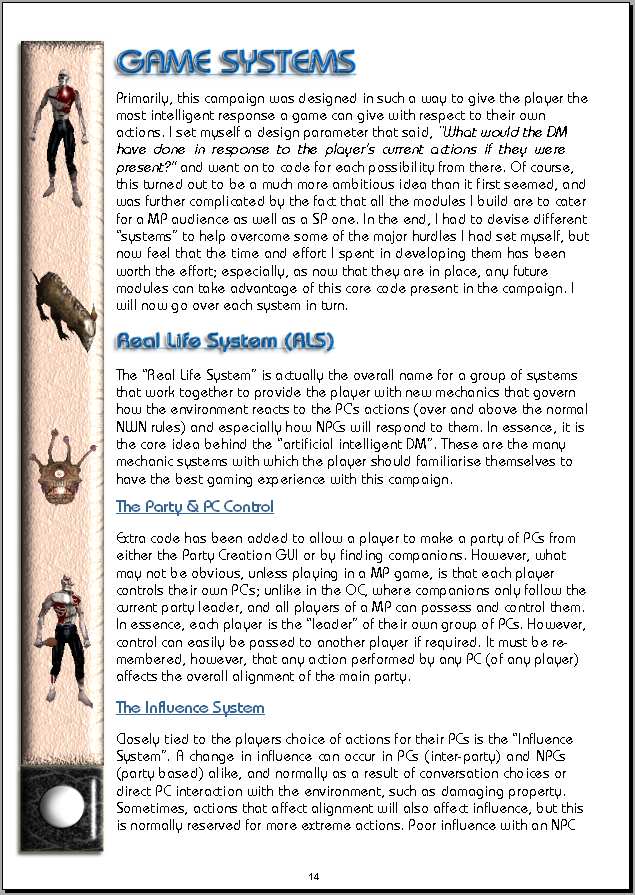
The “Real Life System” is actually the overall name for a group of systems that work together to provide the player with new mechanics that govern how the environment reacts to the PC’s actions (over and above the normal NWN rules) and especially how NPCs will respond to them. In essence, it is the core idea behind the “artificial intelligent DM”. These are the many mechanic systems with which the player should familiarise themselves to have the best gaming experience with this campaign.

And ...

Another aspect of this campaign (different from most others you will have played) is that the artificial intelligence (AI) is designed to respond to a PC’s actions more intelligently, as if there was a DM present who controlled the actions of nearby NPCs. E.g. If you try to damage or interfere with property that does not belong to your PC (or they do not have permission to touch) then nearby NPCs will stop you from tampering with said object until either:

A) The party are able to prevent their actions being detected.
B) Permission is gained from the object owner to interact with the object.
C) The NPC preventing the action is “removed” from the vicinity.

Subject to how the player handles such situations also plays a big part on how their party alignment develops. (See Alignment Changes.) For more information on the different aspects of the Real Life System, please see the Game Systems section of the manual.


Important to note, the Real Life System is fundamental to the design of the campaign and comprises many systems all with the same goal: to help the game respond to player's actions in an intelligent way as possible. Key elements of the this governing system are the alignment and influence systems, which help determine the PCs interaction with other characters.

There are, of course, many other considerations to take into account when creating a system like this, but I have tried to include them whenever possible; including such things as determining if a PC has taken steps to conceal specific actions, and preventing impossibilities such as invisible PCs from speaking to NPCs without choosing to become visible first. The end result is that the module feels much more responsive and alive to the player's actions. My only concern is that some players may find the result too challenging.

FEEDBACK: If you have any comments regarding this aspect of the game (real life responses), then please give me feedback. Tell me of your own experiences and what you have liked or disliked in other games when it comes to this sort of thing. Is there something you would like included or excluded?

The Campaign Manual

As I mentioned above, I have been concentrating on putting the campaign manual together this week. It is not finished and will probably take me a few more weeks yet. The core design is in place, however, and I include a few of the finished pages (also reflecting some of the above post) as images below.


The Title Page


Some Game Parameters


A Unique World


Game Systems Section


Load Material

As writing the manual took most of my time this week, I only managed a little work on the module itself, by preparing the 2da files for the load hints and load screens. I was caught off guard at first, when I discovered it was the nwn2_tips.2da rather than the loadhints.2da that required editing for the load hints, but after I realised this, all was simple enough. Both the 2da files have now been edited, updated and tested as working, but I currently have only one load screen image and a handful of tips edited in the tlk file. It should be a simple enough task to add to these at a later time.

Will You Be Crafting?

We enter the last few days for the latest poll: Will You Be Crafting? If you have not yet voted and wish to do so, then please vote before the time runs out.

Wednesday, 16 February 2011

An Assortment of Updates

There is no one topic for the project to report on for the last couple of weeks, as I have been dipping in and out of various parts of the campaign that need addressing as and when I am inspired. The main reason for this is because I have been trying to give some of my time and energy in supporting people with incorporating my Mapping System into their own modules. And while this did not require a great deal of effort on my part, it did mean using some of the time I had to respond as and when I could. However, I was more than happy to oblige where possible and it gave me a chance to talk (email) others about their own projects. Furthermore, the good news from this is that there are now two modules (that I know of) that are looking at being re-released with the new mapping system incorporated. I have already had the chance to look at one these modules, Risen Hero, and can say that the "fog of war" system that comes with mapping system I devised does indeed add an extra level of intrigue during play. The other module, currently under conversion is Trinity, by E.C. Patterson. Watch out for their re-releases on the Vault.

Campaign Manual

I have also decided to put together a brief manual for the campaign to help prepare players for their gaming experience with Better The Demon. This is because there are enough differences in the normal NWN style of play to warrant some background information for the player. The "serious" gameplay approach that the game presents will be explained as well as other more common playing elements like death and crafting. All such elements have undergone changes and the player will be left somewhat bemused as to what is happening if I do not give them some sort of manual with which to refer. At the moment, however, the manual is nothing more than a few rough notes jotted down in my paper notebook.

Crafting With The Greater Essences

Talking of crafting, I did write a few more pages to the new crafting recipe book that details crafting using the greater essences. I know this book will serve little purpose in the initial module (as it requires the PC to be at least 8th level to use - which is still 4 levels lower than the OC anyway), but I did want the book to be available from module one, so that the player can start to plan their crafting of items ahead of time. I know most readers like to see screenshots, so here are a few of some of the opening pages to, hopefully, whet your appetite: (I am aware of the typo on the 4th page. There may be others that will be addressed in time.)


Thursday, 3 February 2011

Area Map - Fog of War!

How many times have you had your "desire for exploration" frustrated because of being given a whole map of an area even before you started exploring it? What ever happened to the good old "fog of war" (FOW) that represented the parts of an area we weren't familiar with yet? Well, I can at last declare that after giving it more thought, I have finally achieved this for NWN2! For the astute among you (E.g. E.C. Patterson's post on the previous Map Blog), I did indeed manage to rework the "grid" idea that I used with the Rune Puzzle into a "fog" for an area map.

The task was simple enough in the end, but something I had to keep going back to because it required the repetitive task of copying and pasting lines of data, which then needed slight alteration. My concentration only holds for short periods of time and so I had to break the task over a number of days. I am, however, most pleased with the end result. Furthermore, this new system works alongside my previous system for making the "Map Unavailable".

Area Mapping

There are some changes to the way the area map works, simply because the area map function now relates to what the PC knows about the area or has "mapped". Pressing "M" on the keyboard now brings up the map fully zoomed out and giving the maximum view. It is no longer possible to zoom in on an area map, because the map is meant to be a fixed reference that the PC has made for themselves. Note, however, the mini-map (accessed by pressing "N" on the keyboard), still has the + and - zoom buttons to focus in on the immediate area that this map provides. You will also see from the screenshots that the mini-map has been redesigned to give a slightly larger view than it did originally. (It is not subject to FOW.)


The PC starts mapping by opening the area map.


Furthermore, as the area map now represents what the PC is mapping, this map only updates when the player has the map open. If they move around an area with the map closed, then the map is not updated and the FOW is not removed. The map will also automatically close if the PC enters combat. There can be no map referencing while the PC is in combat. Mapping has been made personal to each player. Therefore, in a MP game, players will have maps with differing levels of FOW removed according to where they have explored and mapped. This information remains intact between area changes.


The Fog of War updates as the PC wanders across the area mapping.


An example of where the PC stopped mapping and moved before starting mapping again.


The Map System

The new system was designed to allow the builder to ensure a map is not immediately available to the player. However, there are circumstances when an area is either too small (only one or two rooms), or said to be known well enough by the PC to be provided with the full area details from the start. The system takes this into account, allowing the builder to enable or disable the initial FOW as required.

Current testing has shown the system to be robust and works well for both indoor and outdoor areas and even for custom size areas beyond the standard sizes. It makes only one assumption: that an exterior area has a 4 tile border, which I have not seen differently to date. However, if this is not the case, there is provision for the builder to add a couple of variables to the area in question to correct for this if need be. NB: I have NEVER seen this as a problem to date, and it may not even be possible to build an exterior area without the border in question.

Other News

I have decide that I will be releasing Module 1 prior to finishing modules 2 and 3. This is so I can start receiving feedback and make corrections I may need to make along the way. To this end, I have updated the left side pane to show the percentage completion rates for each module.

For the time being, I have placed the two other puzzles I had in mind on hold, so that I can concentrate on trying to finish the first module. I decided these puzzles and others I have in mind could be integrated at a later date if need be.

Crafting System Poll

Thanks to those who voted on the current poll. It is good to see that the alterations to the OC crafting system I have made are encouraging some to look at crafting in this module more positively. If you have not voted yet, then please do.

Thursday, 27 January 2011

Mini Game Puzzles

Do you enjoy mini-game puzzles? When playing D&D, back in the days when everything was done with a pencil and paper (and almost too far back to remember now) I used to enjoy creating puzzles for my players to try to solve. It was all part of the great gaming experience that made D&D what it was (in my opinion) and while some players might baulk at the idea of finding one, the majority would approach the puzzle with enthusiasm for the challenge. From the poll I took in August last year, it would seem about 55% of players (who read my blog) also enjoy puzzles.

When it comes to designing puzzles in a CRPG, however, a builder is limited to their knowledge of the scripting language, and XML if they want to design new interfaces for puzzle interaction. Furthermore, designing a puzzle to be included in such a way as to not appear orchestrated can be difficult to achieve. This last point, however, is also true for classic D&D. Yet, these obstacles aside, I believe there is room for a little "poetic licence" to allow the builder to be creative with their ideas and include puzzles as a minor distraction to the normal flow of events. If a player can accept the game with this premise in mind, then it can be fun all around.

Not Everyone's Idea of Fun

I do recognise, however, that some players do not like puzzles at all, or find some puzzles a frustration rather than an enjoyable distraction. With this in mind, I have tried to ensure the player does have an alternative means to bypass a puzzle and to move the game forward. Such bypassing does come at a cost (gold or Life Essence), but this should not be seen as being penalised, but as the minimum cost that would have been asked if the puzzle did not exist in the first place. E.g. I posted about my Coded Mechanism Puzzle in an earlier blog. In this puzzle, the player can choose to try to solve the puzzle to move the plot forward at no cost or use Decipher Tools to bypass it instead. If the puzzle had not existed, the same obstacle would have cost the player an amount of gold equalling the cost of the Decipher Tools that were used to bypass this puzzle. In other words, a DM or builder provides a puzzle to allow the player to get something for nothing if they take the time and effort to try to solve it.

A Little More Help?

The other problem with designing puzzles for a CRPG is that there is no immediate contact with a DM to offer hints and clues to solve the puzzle (unless playing with a DM). For the games where no DM is present (SP gaming), I have designed a new feat for the player to take for their PC, called Expert Decoder. This feat is geared towards players who enjoy puzzles, but feel they need just a little more guidance or more time to solve them where a time limit is involved. If this type of player takes the new feat during character build or when levelling, then the extra hints and time come as a reward for their PC learning choice.

The Puzzles

I have already mentioned the Coded Mechanism and have also mentioned my Combination Chest puzzle in an earlier post. There are also a few others that I touched upon, like the Chameleon Puzzle. I will now mention a few others I have been working on, with their differences relating to being bypassed or if the Expert Decoder gives any benefit:

RUNE WARD PUZZLE: Some locks are protected by dwarf rune magik. No normal lock is presented, but a magikal lock that only an agile mind and a good dexterity can overcome. Basically, the player is presented with a grid that represents the locking mechanism and its components. Once activated, the player must match the number of runes required to deactivate the mechanism within a time limit. Some locks are harder to bypass than others, but all allow the PC to sacrifice Life Essence to bypass the lock if need be. Furthermore, a PC with the Expert Decoder feat is allowed a time bonus when trying to deactivate the lock.

Player Starts A Rune Ward Puzzle (This one has four parts to solve.)


Time Ticks Away! (Found one half of a pair, but also drawn a blank!)


One Pair Found! Only Three More To Go! (And only 45 seconds left!)

CYPHER PUZZLE: Sometimes the PC will be up against an intelligent foe. Knowing their plans may be foiled by interfering adventurers, they ensure their communications with their troops are kept encoded so that only those that know the code can translate the message. However, if any of these messages do fall into the hands of the PCs, then they may spend some time looking at the text to see if they can crack the code and understand the message. There is no time limit involved when trying to decipher a text and there is currently no way to bypass this puzzle. However, the PC who has the Expert Decoder feat does get a clue if they are proceeding correctly.

Player starts a Cypher Puzzle (Instructions given.)


This was a test for my wife. (In case you interpret it.)


The yellow letters represent a correct letter if you have the Expert Decoder feat.

RIPPED SCROLL PUZZLE: A page with some useful information has been torn and thrown away. The PCs manage to gather these parts and want to see what was on the page: an important letter, a picture containing a clue, or just an old shopping invoice? This is a simple 25 piece block puzzle. The player is presented with a jumbled image comprised of 25 scrambled parts of an image. As it currently stands, there is no time limit to this puzzle, but neither is there any way to bypass it or gain an advantage with the Expert Decoder feat.

Player Is Presented With The Ripped Scroll Puzzle Instructions.


No Spoiler Text Here - But An Example of A Part Being Swapped

OTHERS (IN PLANNING STAGE)

SINGING GEMS PUZZLE: Maybe an important magikal lock or a simple tavern game, I am yet to decide. Maybe both? The player is presented with a number of gems (4 - 8) that begin to play their strange tuneful chime when the player interacts with them. The gems play a note in turn and the player has to repeat the tune; the number of notes gradually increasing. (Think of the game called "Simon".)

LOCK SPRING PUZZLE: The PCs have come across another magikal lock. This one, however, looks as though it can be overcome by careful examination of the mechanism and some luck. The player is presented with a grid that represents the hidden mechanism. The player then has to start clicking on the different pieces of the lock in an effort to understand its mechanism and work out where each lock part is. (Think of the game called "Minesweeper".)

Means To An End

With all these puzzles, however, I want the player to realise while playing them that they are more than simple games, but a means to overcome an obstacle that will move the plot forward, with the exception of the potential tavern game, which can have its own interesting twist.

Final Word & Request

In every puzzle, I have tried to give extra thought and attention as to how it will work in a MP environment as well as a SP game. For instance, I have decided that while all players may have the Cypher Puzzle open to see, only one player (the one who first discovers the puzzle) can operate the buttons. Note, however, there is nothing to stop this player from leaving the puzzle and allowing another player to act as the main player instead, leaving the first as an observer instead.

I have asked this before, but will ask it again: In the light of the current puzzles explained, do you have any thoughts or suggestions to add? Most of all, is there a puzzle or mini game concept that you would like to see if possible? I have tried to take on board comments in the past, and have greatly appreciated feedback to date. If, however, you believe I have missed an important point, then please let me know.

Of course, any general feedback is very much appreciate as well :)

Tuesday, 18 January 2011

Making The Area Map Unavailable

Have you ever wanted to prevent the player from having access to the maps available? Maybe, as designer, you deem an area would be too complex for the PC to map. Or, maybe, you do not want to allow a map to be available unless they have mapping equipment? Whatever the reason, I believe there are times when disabling the in-game map can have a dramatic effect and potentially change the pace of the game. In the past, however, the methods I have seen to do this appear cumbersome to employ: needing to add blocking tiles at build time. I hope the system I now propose and am using in my own module, Better The Demon, will be more flexible and appealing to builders.

Altering The GUI

I have found that it is possible to use a very simple method of obscuring the current map with another image when the area (or mini) map displays. In the images below, I have simply overlaid a plain black image with the wording "MAP UNAVAILABLE", but there is nothing to stop the builder being more imaginative with the image to place as a map instead. For instance, some builders may like to force hand drawn maps as images rather than allow the automated ones that come with the game. Note, such images still allow Map Pins to work with them, so the builder can allow information updates with such as normal. My own Map Pin system also still works fine with this.

The beauty of this system, is that the ability to obscure or reveal the map is handled by a variable, which means the map can very easily be made available or unavailable by code. Furthermore, there is nothing to stop a builder from updating/changing the same map image with a little more script. E.g. The first map image may only be a rough sketch of the area. When the PCs find a more updated map, then the image can be swapped to represent the more accurate map they have found. I also currently have it set up so that either just the area map is made unavailable (leaving the mini-map available) or that both are made unavailable by adjusting a single variable.

More Crafting Improvements

Over the last week, I have been working on another crafting idea, which I cannot reveal at the moment, as it would be a spoiler. However, while working on this, I recognised a few changes I could make to the existing code to improve some of the things I had already done:

1) I have further reduced the costs of upgrading a scroll, potion or wand to a higher spell casting level. The same minimum cost has been kept, but I felt the player was more likely to consider upgrading an item if the cost to do so was not too great. E.g. The basic cost to create a potion of cure light wounds is 9gp for 1st level. If the caster is capable of casting higher level, the cost examples of this level potion are now 10gp for 3rd level, 12gp for 5th level, 14gp for 7th level and so on. Note, in this particular case, creating a cure light wounds of a level higher than 5th does not produce any further benefits as the spell only gives HP bonus up to 5th level. In this example, the player may prefer to pay the extra 3gp to create a 5th level potion as opposed to a 1st level one to gain the extra guaranteed 4 HPs when taken. As the cost of an empty potion bottle is 1gp, then the player can create their own cure light wound potion for a minimum of 10gp, which is cheaper than the normal cost (11gp). For the small extra cost at time of crafting (3gp), the PC will acquire a potion of cure light wounds set to cast at 5th level.

2) I have added the Spirit Shaman and Favored Soul classes to the Craft Wand creation checks to ensure they can use any wands they create. From what I could see in the official code, it looked as though these classes could craft wands, but not be able to use them. I felt this was a major hindrance to these classes ever wanting to craft wands and so made the changes necessary to allow them to use their own wands. Please note, I recognise that there may be other classes that fit this category, but they will have not been added as they will not be allowed in the campaign as they are anachronistic classes to Althéa. Furthermore, I have only included classes that cast the normal divine or arcane spells, which means warlock spells still cannot be used to craft items.

Will You Be Crafting?

First, I would like to thank the handful of people who added their vote to the current poll last week. Again, however, I am asking for your vote to help give me a bigger picture of the player's interest in this topic, based upon their current thinking, or if they have had any change of interest since following the blog and read about the alterations I have made.

Shatiel left a great post last week, which helped me to confirm some of my own observations. However, the more feedback I receive, the more I can understand other player's interests and concerns in these matters. Any and all constructive feedback is welcome. E.g. I discovered the problem with Spirit Shaman's and Favored Souls being unable to use any wands they craft. That would have frustrated my play when it came to crafting such items. However, did you already know this? Or, are there other current implementations around crafting that annoy you or simply prevent you from bothering with it. If you are a keen crafter already and/or have no reservations anyway, simply answer "Yes! Everything! I always do!" If not, however, then your feedback is valuable. More can be read about this poll from here.

Preventing Exploitation

I have also continued to ensure certain aspects of the game cannot be exploited. Some may say "why bother?", but as a number of the systems I have used work on chance or careful deduction at a cost, then there is always the temptation for a player to simply reload a game to "have another go until they succeed" or "get the answer without paying for it". When this happens, it quickly devalues the achievement and discourages the player. I know there is also the argument that "if that is the way they want to play it, then let them, as they only spoil it for themselves". However, I personally believe I would be doing them an injustice if I was not trying to make the challenge as challenging as possible. I want there to be a point to the process of solving a puzzle or making that lucky roll. Please note, I am not going berserk here and watching every move, but simply preventing potential exploitation of my own designed puzzles and games of chance. In other words, reloading won't stop a player from having another go at an enemy who defeated them last time, but will prevent a player from paying to learn of some information and then reloading prior to that knowledge to get their gold back. Also note that these type of exploitation checks are only required where variables are not set during gameplay and so are kept to a minimum. They do include, however, some puzzles that a friend who has also played the game can give the answer to and so avoid paying the gold. I do not mind this kind of co-operation between players though, as it means they are discussing the module. :)

Tuesday, 11 January 2011

RWS Tilesets (All In One)

I think many will agree that The Robinson Workshop has created some great custom content for us builders to enhance the gaming experience for our players: from creatures, placeables and scripts, right through to great tilesets. Check out their Vault submissions if you have not done so already. I have already incorporated many of their creatures and had the opportunity to start work on including some of their tilesets last week. To this end, I downloaded and installed their All In One pack.

Unfortunately, I have not done much at the moment, as I discovered that some of the tiles and metatiles that I wanted to use, did not work in the toolset. At first, I thought I may have messed up the 2da's, but after reloading a toolset with the additions from scratch, I was still unable to access them. After some investigative work, I managed to track down the problem to 23 missing files and a different setting in the tiles.2da. Now, at this stage I have made the assumption that this is an error, but it may be that RWS have updated their Deep Sewers tileset to disable these particular tiles and metatiles on purpose, but I doubt it. I have contacted them already to let them know and am now posting the solution here for others who may be interested. (Although, by the time you read this, RWS will have probably already sorted the problem.)

UPDATE: RWS Response : "To be honest I'm not sure our All-in-one is really up to date, I stopped supporting it and rather we just put up links to our master 2da files here - then people can just download the various packs from their individual inks. Occasionally we do not include a tile into a set even if it appears in the hak, sometimes this is because we find the tile to not always work as intended or for whatever reason we never just finished the tile in time for release. In your case you are quite correct and it appears that the sewer set was updated after the release of the all-in one and it never got carried over for some reason - most likely laziness on my part :)"

After comparing an older ds.hak (from the Deep Environment hak) and the hak that comes with the All In One, I was able to determine that the following 23 files were absent from the newer hak. (See screenshot.) As far as being able to access the narrower passageways that were also available from the older hak and absent in the new, I was able to increase the variation count for the hallway tile from 3 to 8 in the tiles.2da, which then allowed me to access the other variants of the passageway. (See screenshot.)


In the process of my checking, I did not notice any other files missing from the other Deep Environments, and in quick testing these appeared to work as described. (I will report back if I find anything to the contrary.)

What About This Crafting?

The latest poll has not had much feedback and I am left wondering why? After all, there are options to say a person won't craft, so it's not as if a person cannot say they won't be crafting at all. Is it because I ask for suggestions in the same poll? Or have I not made myself clear in the alterations I have made that will (hopefully) enhance the experience? Maybe it's just too soon after the winter break? Whatever the reason, please let me know ... or just vote and don't give any feedback. I know there has been traffic (stats feedback), so it's not due to lack of readers.

Latest

I feel like the first module is finally coming together and that an end is in sight. Or, to put it another way: I feel like I have found all the borders of a jigsaw puzzle and have constructed the outer frame, and that now I am left with just filling in the middle bits. There are still a number of conversations to write, and some quests to put together, but these remaining ones should ... I repeat, should, be easier to do. However, having just spent some time working out a problem with a tileset, it is easy to find oneself having to resolve other issues along the way.

Islander

After an annoying incident where I lost my NWN saved games, I decided to start a new adventure rather than walk the path of those I had played again. (I will try playing them at a later time when they feel fresh again.) As I had been in touch with Eguintir Eligard (who is also in the process of designing some areas for my module), and who has just released his Islander - The Dagger Forged module, I decided to take a look. I don't get the time to play much, but this module does seem to hold up reasonably well from the amount I have played to date. There were one or two things that suggested it was not "polished" (I have already spoken with Eguintir about them), but, overall, the module leaves me with a feeling of wanting to continue to play to learn more about the story, which is a good thing! Furthermore, I was especially impressed with the music in Merchant Island (composed by Hoegbo of Demon Melody), which reminded me of the music from Monkey Island.

That's all for now .... please vote on the crafting poll. (Left pane.) Original poll post.